
Student Sublease vs. Lease Transfer vs. Lease Takeover: What’s the Difference and Which Is Right for You?
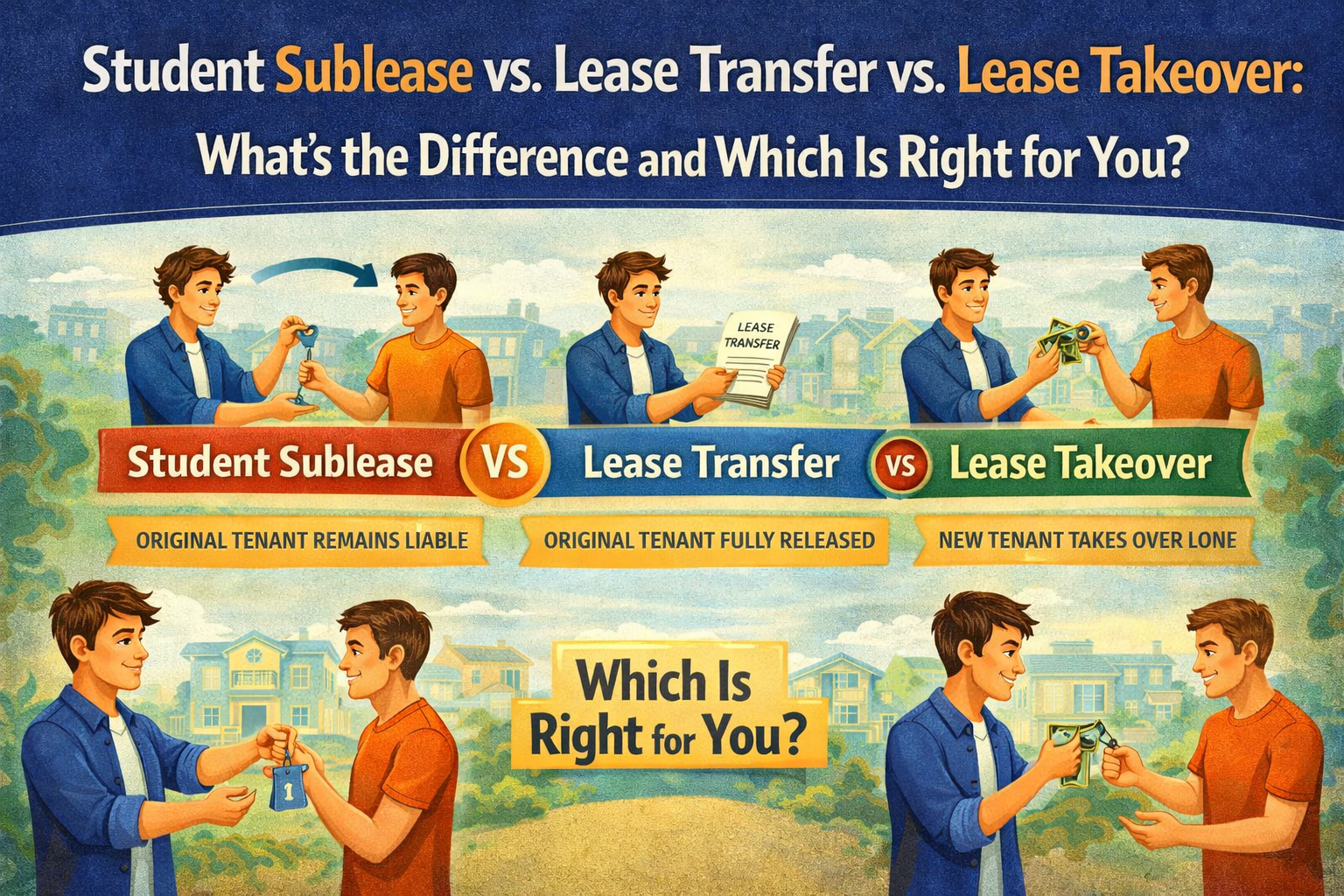
A sublease, a lease transfer, and a lease takeover are three different arrangements with different legal consequences. Choosing the wrong one can leave you financially responsible for a unit you have already moved out of. The core difference comes down to one question: does your name leave the lease or stay on it?
TL;DR: Quick Answer
- A lease transfer (assignment) permanently removes you from the contract. The incoming tenant takes over your exact role and deals directly with the landlord.
- A sublease keeps your name on the original lease. You become a de facto landlord for the subtenant and remain liable for everything that happens in the unit.
- A lease takeover is not a distinct legal category. It is the same event as a lease transfer, described from the incoming tenant’s perspective.
- The only arrangement with zero residual exposure is a lease transfer with an explicit written release from the landlord.
- Subleasing is the right tool for temporary absences with a planned return. Lease transfers are the right tool for permanent exits.
The Core Legal Distinction
Before the definitions, one principle explains everything else: in a sublease, the original tenant remains liable to the landlord. In a lease transfer, the original tenant’s liability ends when the assignment is signed and the landlord issues a written release.
Most students who get burned in these arrangements did not fail to find someone to take their apartment. They failed to document the arrangement correctly and ended up liable for damage or missed rent they had no control over.
Option 1: Lease Transfer (Assignment)
A lease transfer, the correct legal term being a lease assignment, permanently moves your entire lease to a new tenant. The incoming tenant (the assignee) steps into your exact role: they pay rent directly to the landlord, they are bound by all your original lease terms, and they take full responsibility for the unit going forward.
This is the only option that can permanently end your legal obligations. One important nuance: even after a formal assignment, some landlords retain the right to pursue the original tenant as a secondary guarantor if the incoming tenant defaults. This varies by state and by the specific language in your assignment agreement. Always request a written release from your landlord that explicitly states you are no longer liable before considering the process complete.
Who it is best for: Students who are permanently leaving their housing situation, whether due to a school transfer, early graduation, a move to another city, or financial circumstances that make continuing the lease impossible.
What it requires: Landlord approval in almost all cases. The incoming tenant must meet the same income and credit criteria the landlord required from you. Pre-screen candidates before presenting them. The process typically takes 7 to 21 business days from application to signed documentation.
Security deposit: Your original deposit is either returned to you after a move-out walkthrough or formally transferred as part of the assignment agreement. Clarify this in writing before anyone signs anything.
findmyplace.co’s contract marketplace is built specifically for this kind of transaction. Listings are campus-specific, and students searching for housing see the exact term, price, and location you are offering.
The limitation: This is not a fast process. Do not wait until the last minute. Every week you delay is a week you remain financially responsible for the unit.
Option 2: Lease Takeover (from the Incoming Tenant’s Perspective)
A lease takeover is the same legal event as a lease transfer, described from the incoming tenant’s point of view. When someone says they are doing a lease takeover, they mean they are stepping into an existing lease that another tenant is exiting. The legal mechanism is identical: assignment of the original lease contract, with landlord approval required.
The reason to address this separately is that the incoming tenant’s risks differ from the departing tenant’s risks. Students who do not understand what they are inheriting can encounter problems that follow them for the rest of their tenancy.
What the incoming tenant is actually taking on:
The original lease terms. You inherit the existing contract as written, including any clauses that restrict subletting, require specific notice periods, or impose fees. Read the full document before signing anything.
The unit’s existing condition. Walk through the apartment before agreeing to anything. Document every scuff, stain, and broken fixture in writing and photos with timestamps. Pre-existing damage that is not documented on your move-in can be charged to your deposit when you leave.
The remaining lease term. You are committing to a specific end date. If that end date does not align with your academic calendar, a lease takeover can create the same exit problem for you several months later.
Who it is best for: Transfer students, students returning from study abroad who need housing mid-semester, and students who need a shorter commitment than a standard 12-month lease.
Practical advantages: Lease takeovers are often available at below-market rent because departing tenants are motivated to transfer quickly. Many also come with furniture the departing tenant is leaving behind. With a takeover through findmyplace.co, incoming students often skip the standard application-to-approval timeline for a new lease and can move in within one to two weeks.
The limitation: You inherit whatever terms the departing tenant originally signed. If the lease includes a restrictive subletting clause, a rent rate above current market, or a history of slow maintenance responses from the landlord, those conditions become yours for the remaining term.
Option 3: Sublease
A sublease differs from the other two options in one critical way: your name never leaves the original lease. When you sublease your apartment, you become a de facto landlord for the subtenant. You collect rent from them, pay the original landlord, and remain fully responsible for everything that happens in the unit until your original lease expires.
This is not a clean exit. It is a financial management tool. If the subtenant stops paying rent, damages the unit, or violates lease terms, the landlord comes to you. You then pursue the subtenant separately. Some students discover this after returning from a semester abroad to find a damaged apartment and a landlord holding them responsible for repairs.
That said, subleasing is the right tool for a specific situation: temporary absence with a planned return. If you are leaving for one semester and coming back, a sublease covers your rent, preserves your unit, and does not require you to find a permanent replacement.
Who it is best for: Students leaving for one semester to study abroad, complete an internship, or do a co-op, with a definite return date.
Practical advantages: Many landlords are more willing to approve a sublease than a full assignment because it keeps the original, screened tenant on the hook. Approval can often be secured in 3 to 7 days. When the sublease ends, you return to your unit with no reapplication, no new deposit, and no renegotiation.
Critical requirements: Get written landlord approval before the subtenant moves in. Subletting without permission can result in eviction of both you and the subtenant. Document the unit’s condition with timestamped photos and video on move-in day. Use a written sublease agreement that requires the subtenant to follow all terms of the original master lease.
Side-by-Side: Which Option Fits Your Situation?
| Your Situation | Best Option | Why |
| Permanently leaving due to transfer, graduation, or financial hardship | Lease Transfer | Full legal exit when properly executed with a written landlord release |
| Leaving for one semester, returning afterward | Sublease | Preserves your unit; subtenant covers rent temporarily |
| Need housing mid-semester or with a shorter term remaining | Lease Takeover | Inherit an existing lease that matches your remaining timeline |
| Landlord will not approve full assignment | Sublease first, then pursue transfer | Sublease provides financial relief while you continue pursuing a permanent exit |
| Incoming student avoiding a full 12-month commitment | Lease Takeover | Take over remaining months of an existing lease instead of signing a new full term |
Who Is Responsible if Things Go Wrong?
In a sublease, you are always responsible to the landlord. Your subtenant is only responsible to you. If they damage the apartment, the landlord bills you.
In a lease transfer, the assignee becomes responsible to the landlord directly. You may still be named as a secondary guarantor unless the landlord provides an explicit written release.
In a lease takeover, from the departing tenant’s side, the outcome is the same as a lease transfer. The incoming tenant takes primary responsibility. The departing tenant’s residual exposure depends entirely on whether a written release was secured.
Zero residual exposure exists only in a lease transfer with an explicit written release from the landlord. Every other arrangement carries some degree of ongoing risk. Understand yours before you sign anything.
Know the Term Before You Use It
The difference between these three options is not just vocabulary. It determines your financial exposure for months after you have physically moved out.
Decide which option fits your situation, then use the right paperwork and the right process to execute it. findmyplace.co’s contract marketplace supports both sides: students listing leases for transfer and students searching for campus-specific takeover options with filters for price and remaining term.
