
Stuck in a Student Lease You Can’t Afford? 7 Legal Ways Out
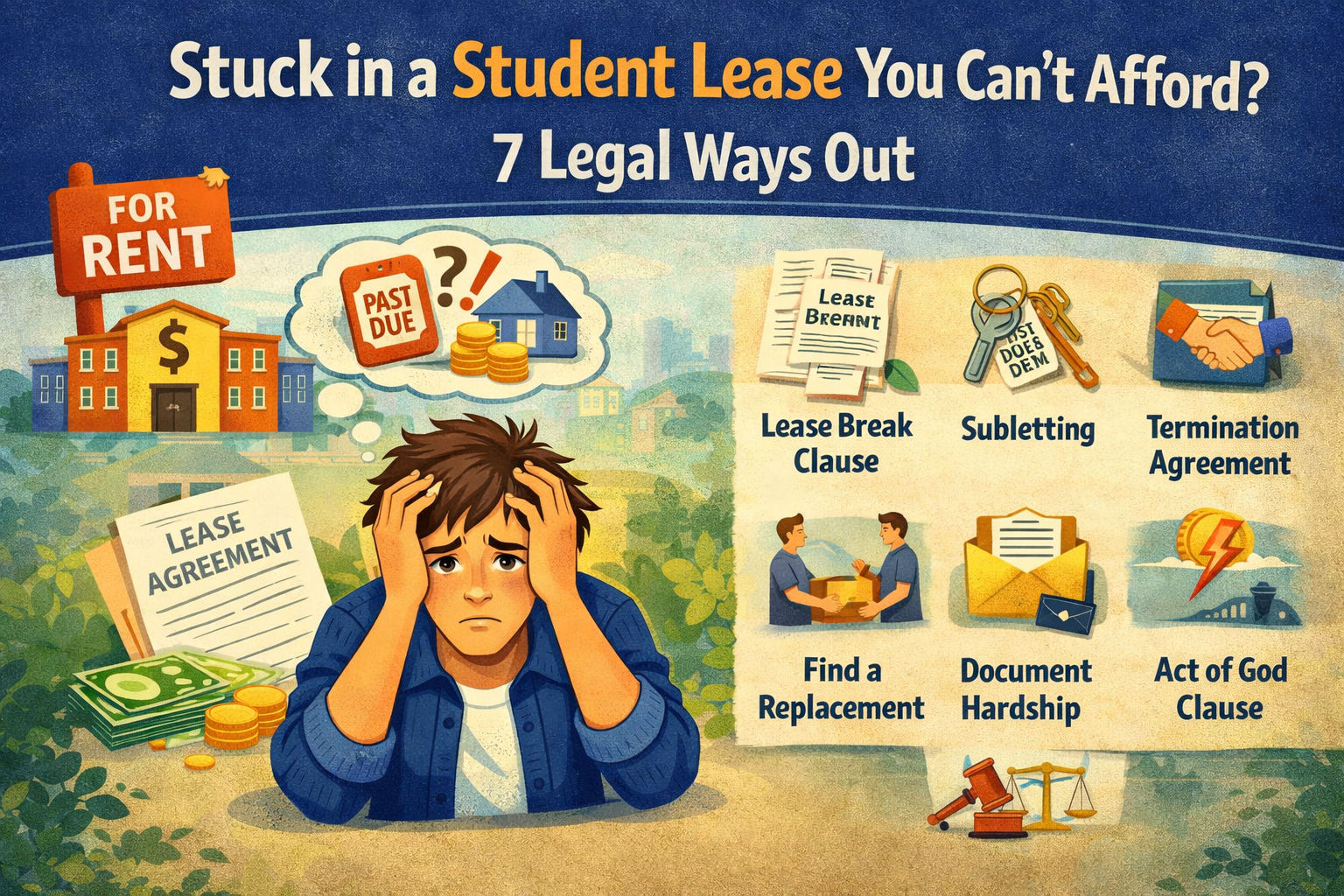
Seven legal exit strategies exist for students stuck in a housing contract they can no longer fulfill, ranging from zero-cost options backed by tenant law to low-cost exits that protect your deposit and credit history. Which one fits your situation depends on your lease terms, your landlord’s flexibility, and the condition of the unit.
The most effective strategy for most students is finding a qualified replacement tenant and executing a proper lease assignment. The others vary significantly in cost, legal completeness, and how much documentation they require.
TL;DR: Quick Answer
- A lease transfer (assignment) is the only strategy that removes your name from the contract entirely and leaves zero ongoing liability.
- Mutual termination with your landlord can work well in strong rental markets where landlords prefer a clean exit over a contested tenant.
- Habitability failures and landlord conduct violations can support a penalty-free exit, but only with thorough written documentation and conditions that meet the legal threshold.
- Subleasing covers costs but keeps you legally responsible for everything the subtenant does.
- Federal law gives active-duty military members the right to terminate any residential lease without penalty under the Servicemembers Civil Relief Act.
Strategy 1: Find a Replacement Tenant (Lease Transfer)
A lease transfer is the strongest exit available to most students. When you find a qualified replacement tenant and execute a proper lease assignment, the incoming tenant steps into your role, your landlord gets continued rent, and you exit the contract with no ongoing financial liability.
Why this works: landlords in most states have a legal duty to mitigate damages when a tenant breaks a lease. They cannot let the unit sit empty and charge you for every remaining month. If you bring them a qualified replacement who meets the same income and credit requirements you met when you signed, their justification for charging you anything beyond an administrative fee (typically $100 to $500) largely disappears.
Students who find strong replacements through platforms like findmyplace.co’s contract marketplace often exit with zero penalty. The platform is built specifically for student lease transfers near university markets, which means listings reach verified student tenants who are actively searching.
What makes this the top strategy: once the assignment is executed and signed by all three parties, your name comes off the lease entirely. No future rent exposure, no co-responsibility for the incoming tenant’s actions, and no residual liability.
Typical cost: $0 to $500 in administrative fees.
Strategy 2: Negotiate a Mutual Termination
A mutual termination agreement is a written agreement between you and your landlord to end the lease before the term expires. This typically involves a buyout payment, a deposit forfeiture, or both. In strong rental markets, landlords are often more open to this than students expect. A contested tenant who cannot pay rent is not in their interest either.
Approach this early and professionally. Offer to help find a replacement, propose a buyout of one to two months’ rent, and get everything in writing before you move anything out. A signed mutual termination agreement explicitly ends your obligations with no ambiguity. It also does not appear on your rental history the way an abandonment or eviction does.
One real limitation: this requires a cooperative landlord. If the management company has strict corporate policies or the landlord is adversarial, negotiation may not be possible. In that case, go directly to Strategy 1 and bring them a replacement tenant.
Typical cost: $0 to two months’ rent, negotiable.
Strategy 3: Invoke the Habitability Defense
Every residential lease in the United States carries an implied warranty of habitability. Your landlord is legally required to maintain the unit in a condition fit for human occupancy. If they fail to do so and you document that failure properly, you may have grounds to exit without penalty.
Conditions courts generally recognize include: cockroach, rodent, or bedbug infestations the landlord was notified of and failed to address; toxic or black mold; no heat in winter months; non-functioning plumbing; broken exterior locks or fire hazards left unaddressed.
The legal argument is called constructive eviction. The claim is that by failing to maintain a habitable unit, the landlord effectively forced you out. Documentation requirements are strict. You need: timestamped photos, written repair requests sent via email, and records of landlord responses (or the absence of responses). You must give the landlord written notice and a reasonable repair window (typically 30 days) before you vacate.
Minor annoyances do not meet the threshold. A slow-draining sink or a broken dishwasher will not support a constructive eviction claim in most jurisdictions. The condition must genuinely affect the health or safety of the occupants.
If your conditions qualify, this is a $0 exit. You pay no penalty and are entitled to your deposit back.
Typical cost: $0 if conditions qualify and documentation is thorough.
Strategy 4: Use the Early Termination Clause
Many leases written for student markets in the last five years include an early termination clause with a defined buyout process. If yours does, this is often the most straightforward path available: pay the stated fee, give proper written notice (typically 30 to 60 days), and you are legally released.
Early termination fees in student housing typically run one to three months’ rent. For a $600 per month unit, that is $600 to $1,800. Paying that is painful, but significantly less expensive than continuing to pay rent on a unit you have abandoned or defaulting entirely.
The practical advantage is certainty. You know the exact cost before you start and do not need your landlord’s agreement. You just follow the procedure as written.
One important distinction: some “early termination clauses” require continued rent payments until a new tenant is found rather than a flat fee. Read your specific clause carefully before assuming you know your total exposure.
Typical cost: One to three months’ rent, fixed.
Strategy 5: Sublease to Cover Costs
A sublease is not a clean exit. Your name stays on the original lease and you remain legally responsible if the subtenant does not pay or causes damage. But if a permanent transfer is not possible, subleasing stops the financial drain while you wait for the lease to end naturally or find a full transfer candidate.
Subleasing works best for temporary situations: a semester abroad, a summer internship, or a few months while you search for a permanent replacement. The subtenant pays you, you pay the landlord, and your out-of-pocket costs stop as long as the subtenant is reliable.
Screen any subtenant carefully. Use a written sublease agreement that requires the subtenant to follow all terms of the master lease. Document the unit’s condition with the subtenant on move-in day. This protects you from deposit deductions caused by damage you did not create.
Typical cost: $0 to a small administrative fee charged by some landlords ($50 to $200).
Strategy 6: Invoke Military or Protected Status Provisions
Federal law gives active-duty military members the right to terminate any residential lease without penalty. Under the Servicemembers Civil Relief Act (SCRA), if you receive deployment orders or a permanent change of station, you can exit your lease by providing written notice and a copy of your military orders. The lease terminates 30 days after the next rent payment following notice.
Beyond military provisions, many states have enacted protected-class protections allowing lease termination without penalty. These typically include survivors of domestic violence, sexual assault, or stalking (with documentation such as a police report or protective order); victims of violent crimes that occurred on the rental property; and tenants requiring placement in a medical or care facility.
Check your specific state’s landlord-tenant law before sending notice. Documentation requirements vary. Student Legal Services offices at most universities can identify which protections apply in your state at no cost.
Typical cost: $0 with proper documentation.
Strategy 7: Cite Landlord Breach of Quiet Enjoyment
Every tenant has a legal right to quiet enjoyment of their rental, meaning the right to occupy the unit without harassment, illegal entry, or interference from the landlord. Documented, repeated violations of this right may support a constructive eviction argument and a penalty-free exit.
Conditions courts have recognized include: repeated landlord entry without the legally required notice (typically 24 hours in most states); utility shutoffs used to force a tenant out; and written or verbal harassment, threats, or lockouts without legal process.
This strategy requires the most documentation, the most time, and the highest tolerance for potential conflict. It is legitimate when the conduct genuinely qualifies, but casual disputes over minor issues do not meet the threshold. Do not vacate before consulting your university’s student legal services office. Vacating without legal grounds could expose you to an abandonment claim.
Typical cost: $0 to legal fees if the landlord contests.
The Fastest Exit Is the One You Prepare For
For most students, the answer is Strategy 1: find a qualified replacement tenant and execute a proper lease transfer. It is the only option that removes you from the contract entirely, costs nothing if done right, and leaves no residual liability.
Whichever route fits your situation, start the process as soon as you know you need to leave. The earlier you move, the more options remain open and the more leverage you have in any negotiation.
findmyplace.co’s contract marketplace puts your listing in front of verified students who are actively searching for housing near your campus.
