
Student Housing Amenities: 9 That Actually Matter and 4 That Don’t
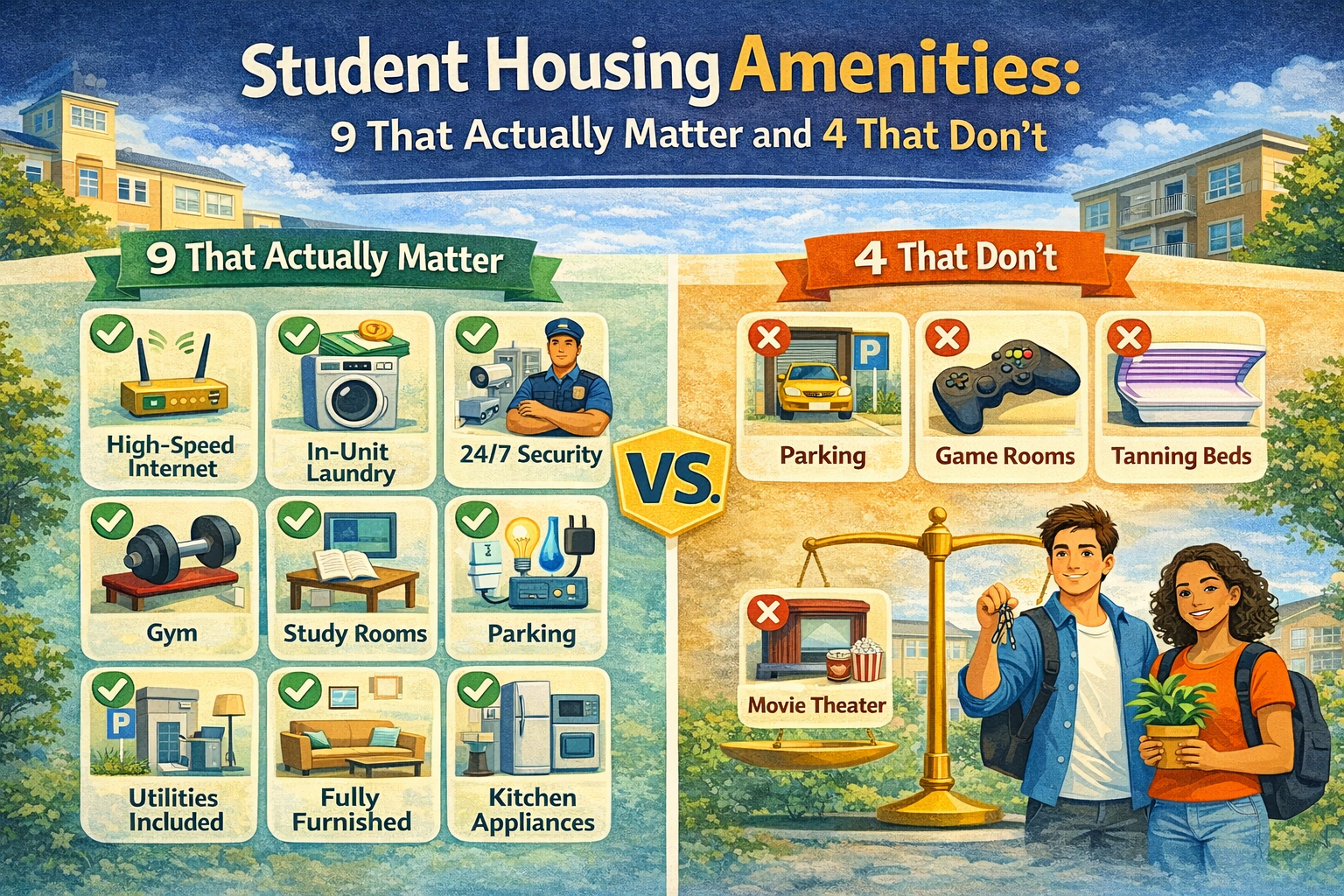
Student housing marketers have gotten skilled at selling amenities that photograph well. Resort-style pools. Rooftop terraces. State-of-the-art fitness centers. These features dominate leasing brochures and drive rent premiums that most students pay and never use.
Research from StudentHousingBusiness.com found that students consistently value functional amenities, fast Wi-Fi, in-unit laundry, utilities, and parking, over premium lifestyle features. A 2025 StarRez survey of 418 institutions found that roughly one-third of students cite room conditions and functional amenities as the primary driver of housing satisfaction. The yoga studio is not on that list.
This guide ranks the nine amenities that actually improve your daily life as a student and identifies the four you’re most commonly overpaying for.
TL;DR: Quick Answer
- Fast, reliable Wi-Fi is the single most critical student housing amenity; a building with included high-speed internet saves $600 to $960 over a 12-month lease versus setting up your own service.
- In-unit laundry, a private bedroom with a lock, and responsive maintenance round out the essential tier and consistently appear as top drivers of student satisfaction in verified reviews.
- Resort pools, premium fitness centers, hot tubs, and game rooms rank lowest in student satisfaction data and rarely justify the rent premiums attached to complexes that market them heavily.
- Before signing, read peer reviews on Find My Place to verify what amenities a complex actually delivers versus what it advertises.
- Parking is essential if you have a car and worth zero if you don’t; confirm whether it’s bundled into rent or genuinely optional before comparing costs across buildings.
The 9 Amenities That Actually Matter
1. High-Speed, Reliable Wi-Fi
Wi-Fi is the most critical amenity in student housing, and the gap between buildings that do it well and buildings that do it poorly is significant. Every core function of modern college life, remote coursework, Zoom lectures, research, streaming, and communication, requires an internet connection that holds up under load. Specifically, under the load of four students in the same unit all using bandwidth simultaneously during finals week.
Many complexes advertise “complimentary Wi-Fi” and deliver a shared building-wide connection that degrades during peak hours. Ask the right questions before signing:
- Is Wi-Fi a dedicated line to each unit or a shared building connection?
- What is the plan’s speed in Mbps?
- Is there a data cap or throttling after a usage threshold?
The financial case is straightforward. A building with reliable included Wi-Fi saves $50 to $80 per month versus setting up your own service. Over a 12-month lease, that’s $600 to $960.
2. In-Unit Washer and Dryer
In-unit laundry eliminates three ongoing costs: the time of hauling laundry to a shared facility, the money cost of coin-operated machines ($2 to $4 per load), and the friction of competing for machines with other residents. A student running three loads per week at a coin laundry spends $25 to $50 monthly. In-unit laundry, even if it adds $30 to $50 to rent, pays for itself immediately.
Two things to verify before assuming a unit has this amenity. First, some units offer washer/dryer hookups but require you to supply the machines, adding $50 to $100 monthly to rent appliances or $800 to $1,200 to purchase them. Second, a well-maintained on-site laundry facility is a reasonable alternative to in-unit, but “on-site laundry available” is not the same as in-unit. Read reviews specifically for laundry comments before accepting the distinction as equivalent.
3. Private Bedroom With a Lock
A private bedroom with a lockable door is the foundational privacy condition for effective studying, adequate sleep, and personal space. Without it, every aspect of daily life is negotiated with another person. A 2025 StarRez survey found 51 percent of students rank single rooms as their top housing preference. Demand consistently exceeds supply for single rooms on campus, which drives the growth of off-campus purpose-built student housing where private bedrooms are the standard configuration.
Shared bedrooms are a legitimate financial trade-off for budget-constrained students, particularly in high-cost markets where private rooms run $600 to $900 per person and shared rooms run $300 to $500. Go in knowing exactly what you’re trading.
4. Responsive On-Site Maintenance
Responsive maintenance is the most underrated amenity in student housing and the most commonly cited negative in student reviews. When something breaks, the heat in January, the air conditioning in August, a flooding bathroom, how quickly management responds determines whether you live with a manageable inconvenience for 48 hours or a significant problem for three weeks.
You cannot evaluate maintenance quality from a listing photo. You can evaluate it from reviews. When reading Find My Place reviews for any complex you’re seriously considering, look specifically for language about maintenance response times. A pattern of complaints about slow repairs is the single most reliable predictor of a frustrating tenancy. On tour, ask directly: “How do I submit a maintenance request, and what’s the typical response time?” A manager who answers confidently with a specific process is demonstrating the system is established. One who is vague is showing you what the experience will be like.
5. Parking (If You Have a Car)
This amenity is situational: irrelevant without a vehicle, essential with one. Near-campus parking in student housing markets typically runs $30 to $150 per month as an add-on when not included in base rent. A building that includes one designated space per bedroom bundles $360 to $1,800 in annual value into the rent.
Two things to confirm with any property: whether parking is included in base rent or optional, and whether the complex charges parking fees regardless of vehicle ownership. Some do.
6. Furnished Units
The cost of furnishing an unfurnished apartment from scratch, bed frame, mattress, desk, seating, kitchen essentials, typically runs $1,500 to $3,000 buying new or $500 to $1,000 sourcing secondhand. Purpose-built student housing that includes bedroom furniture eliminates this upfront cost and the logistical burden of moving large items in and out.
When comparing furnished versus unfurnished units, include the full furniture cost in your year-one calculation. A $100 monthly premium for a furnished unit saves more than that in a single furniture purchase. For students moving from out of state, furnished units are especially valuable: traveling with or shipping furniture adds cost and complexity that furnished units eliminate entirely.
7. Private Bathroom or Dedicated Bathroom Access
Access to a private or semi-private bathroom is one of the most consistent quality-of-life improvements students report when moving from traditional dorms to off-campus housing. The bathroom-sharing situation in student housing ranges from manageable, two people sharing a bathroom in a two-bedroom apartment, to actively stressful, four students sharing a single hallway bathroom with different schedules. A 2026 Research.com student housing statistics report found 76 percent of surveyed students named having their own bathroom as an important feature. That preference has grown stronger as apartment-style housing has become the standard students compare against.
8. Study Spaces or Quiet Zones in the Building
On-site study rooms and quiet zones are underused by most students most of the time, but the students who use them rely on them heavily. Access to a well-lit, Wi-Fi-connected study space that isn’t your bedroom matters most during finals periods and late-night writing sessions when the campus library closes and your roommates are asleep. This amenity is worth a modest premium if you regularly study outside your bedroom. It’s worth nothing if you primarily study on campus. Know your own habits before weighting this in comparisons.
9. Secure Package Lockers
Package lockers with notification systems have moved from a luxury to a practical necessity for students who order regularly online. The alternative, packages left in an unsecured lobby or delivered to a front desk with limited hours, results in theft at rates that make smart locker security quantifiable in real dollars. It ranks last among the essentials because it’s the most replaceable: a P.O. box, a campus delivery address, or nearby retail pickup lockers are functional substitutes.
The 4 Amenities You’re Most Commonly Overpaying For
Resort-style pools. Heavily used during two months in Sun Belt markets. Students in Arizona and Nevada use them; students in Colorado, Utah, and the Midwest almost never do. A pool that raises rent $75 monthly costs $900 annually for a feature most students use fewer than ten times per year.
Premium fitness centers. Your university gym, included in student fees, is almost certainly better equipped and more conveniently located than your apartment’s fitness center. A rent premium for on-site gym access rarely makes financial sense when a better facility exists five minutes from class.
Hot tubs and spas. Survey data from StudentHousingBusiness.com shows students explicitly rank these below Wi-Fi, laundry, and parking. If a complex’s rent premium traces to these features, you’re subsidizing amenities you’re unlikely to use.
Game rooms and entertainment suites. These score high in marketing material and low in verified student reviews as a reason for housing satisfaction. Students who want to game have their own setups. Students who want to socialize do so in each other’s units or off-site.
The Bottom Line: Pay for Function, Not Photography
The amenities that improve daily life as a student are unglamorous: fast internet, in-unit laundry, a private bedroom with a lock, a landlord who fixes things promptly, and a parking space if you need one. These aren’t the features that photograph well in brochures, but they’re the ones that determine whether your housing works for you every day.
Before signing any lease, use Find My Place peer reviews to verify what a complex actually delivers versus what it markets. “High-speed Wi-Fi” that drops during peak hours, “included parking” that means a shared lot with no guaranteed space, and “on-site maintenance” with a 10-day average response are all worth knowing before you commit to a 12-month contract.
