
How to Choose Your Off-Campus Housing: 7 Factors to Check Before You Tour
Most students approach off-campus housing the wrong way: they browse listings first and decide what they need second. The result is that every apartment gets evaluated on different, shifting criteria, and the final decision ends up driven by whoever gave the best tour pitch rather than by what the student actually needs.
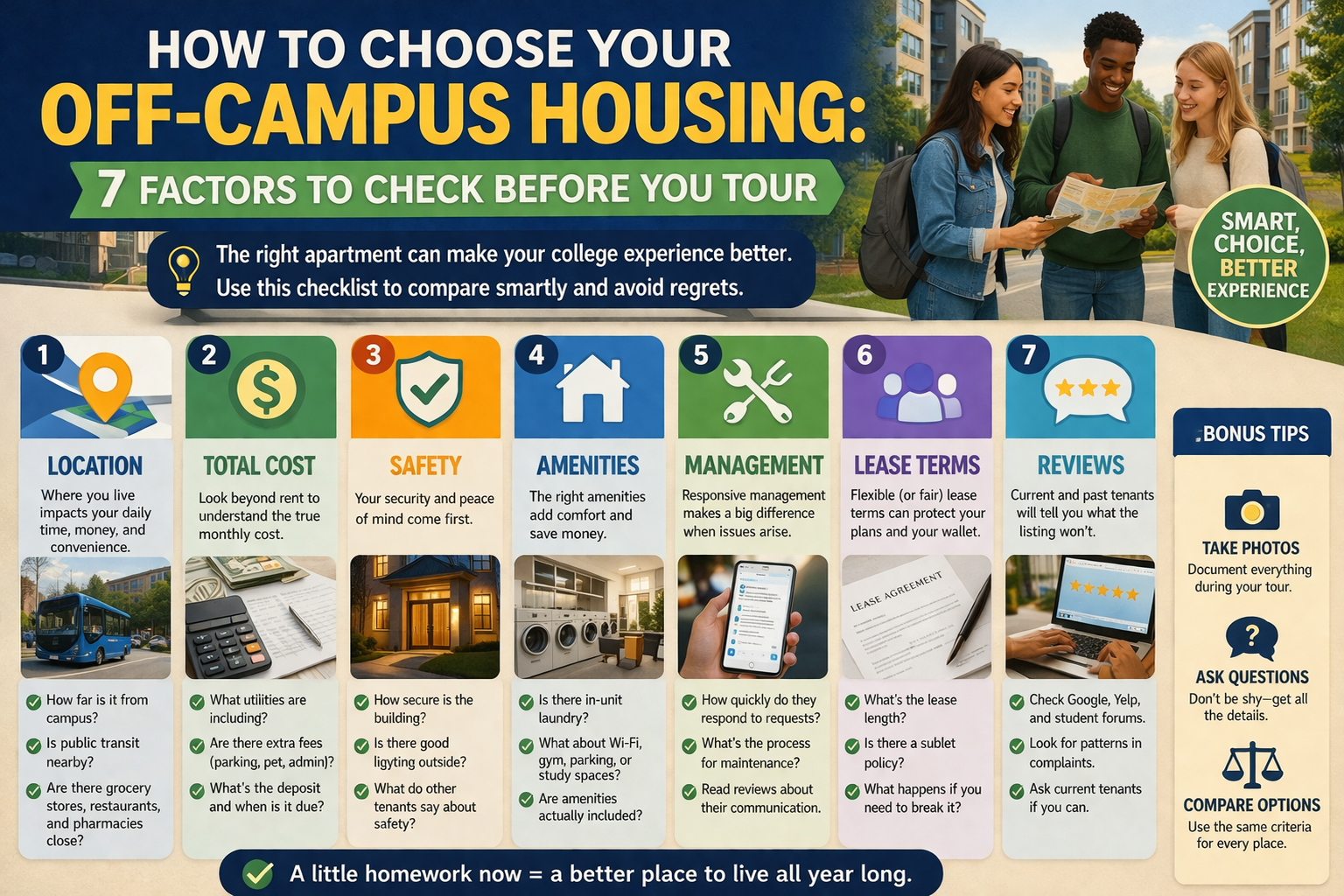
The seven factors below are a pre-screening framework, not a tour checklist. Establish these criteria before you look at a single listing. Every property you tour then gets measured against the same standard.
TL;DR: How to Choose Off-Campus Housing
- Decide your maximum acceptable commute before you start searching — location affects your daily experience more than any other factor.
- Calculate total true cost, not advertised rent. Add utilities, internet, parking, renter’s insurance, and any mandatory fees.
- Understand your lease type before signing. A joint lease makes you financially liable for your roommates’ rent; a by-the-bed lease does not.
- Evaluate management quality using Find My Place reviews before scheduling a tour — maintenance responsiveness is invisible in listing photos.
- Walk the commute route at night and check public crime data for the specific address, not just the general neighborhood.
Factor 1: Location and Commute — The One You Cannot Compensate For
Properties within half a mile of campus command roughly a 33 percent valuation premium over farther units, according to Cushman and Wakefield’s 2025 student housing report. Students pay that premium because commute distance affects your experience every single day, in a way that no amenity or management quality can offset.
A 20-minute commute sounds manageable when you’re signing a lease in February. It feels like a different calculation at 7:45 AM in January or at 10 PM when the library closes.
Before you tour:
Walk or ride the actual commute route at the time of day you would realistically do it, on a day with typical weather. Google Maps estimates do not account for January wind, August heat, or an icy sidewalk. If you plan to bike, identify your backup plan for rain and snow. Units more than one mile from campus need verified transit access — confirm route frequency and last-service times before you commit. Check also what is accessible on foot: grocery stores, pharmacies, and places to eat within walking distance reduce the daily friction and cost of living in a meaningful way.
Factor 2: Total True Cost — What You Actually Pay Each Month
Advertised rent is a starting number, not your actual monthly cost. The real figure adds utilities, internet, renter’s insurance, parking, move-in fees spread across the lease term, and any mandatory amenity or technology charges built into the contract.
A unit listed at $650 per month that includes utilities, Wi-Fi, and covered parking may cost substantially less than a unit listed at $600 with none of those inclusions. Comparing advertised rents means comparing different things.
Before you tour:
Ask the landlord for 12 months of utility bills, not one month. August in Arizona and January in Colorado produce bills that look nothing like the spring average. List every line item beyond base rent: electricity, gas, water and sewer and trash (typically $15 to $35 per person), internet ($15 to $40 per person when split), renter’s insurance ($10 to $20 per month), and parking ($30 to $150 per month if not included). Divide application fees, administrative fees, and security deposit across your lease term to get their monthly contribution to true cost.
Factor 3: Lease Type and Exit Flexibility
You are not just renting an apartment. You are signing a legal contract that governs your financial exposure for the next 12 months, including what happens if your roommate transfers schools, you land an internship in another city, or your financial situation changes.
The academic calendar rarely aligns cleanly with standard 12-month leases. Exit flexibility is not a nice-to-have for many students — it is a necessity they do not know they will need yet.
Before you tour:
Understand the difference between joint and by-the-bed leases. On a joint lease, all tenants share liability. If a roommate stops paying, their share becomes your legal problem. A by-the-bed lease limits your financial responsibility to your own room only — increasingly common in purpose-built student housing. Ask whether an early termination clause exists, what it costs (typically one to three months’ rent), and what notice it requires. Confirm whether subletting or lease assignment is permitted; Find My Place lease transfer marketplace serves students who need to exit mid-year, but only if the original lease allows it. Some properties offer 9- or 10-month academic-year leases at a modest premium over 12-month rates. Sign only for the length you actually need.
Factor 4: Management Quality and Maintenance Responsiveness
Management quality is invisible in every listing photo. It becomes visible only after you have moved in and something needs to be fixed — at which point you are already locked into a 12-month contract.
Maintenance responsiveness is the most frequently cited negative factor in verified student housing reviews on Find My Place. A slow-responding landlord turns every broken fixture or failed appliance from a temporary inconvenience into a weeks-long disruption.
Before you tour:
Search the property on Find My Place and read reviews specifically for maintenance mentions. A pattern of complaints is more informative than a single one-star review. Ask the landlord how maintenance requests are submitted. A specific answer (“through our app, non-emergency response within 48 hours, same-day for urgent issues”) indicates an established system. Vague answers (“just call the office”) signal what your post-move-in experience will look like. Check Google Reviews for the management company, not just the property — a company managing multiple student properties will have patterns visible across their portfolio.
Factor 5: Neighborhood Safety
Safety of the surrounding neighborhood is consistently ranked among top priority concerns by students and their families, according to the Research.com 2026 student housing statistics database. Most university-adjacent neighborhoods in established college towns are safer than general perception suggests — but practical evaluation separates that reality from anxiety-driven avoidance of areas that are actually fine.
Before you tour:
Walk the route from the unit to campus in the evening, not during a daytime showing. Note lighting quality and foot traffic at the time you would actually be using the route. Check the city’s public crime mapping tool for the specific address and compare it to the area around campus — the relevant benchmark is not “is there any crime” but “is this meaningfully different from where I already spend my days.” Look at building security features specifically: card access entry, exterior lighting, and secured parking matter more to your personal security inside the unit than general neighborhood statistics do.
Factor 6: Unit Condition and Infrastructure
Unit condition problems compound. A unit with poor insulation, aging appliances, and signs of water damage does not improve after you move in. It generates ongoing maintenance requests, higher utility bills, and daily friction across 12 months.
During every tour:
Check ceiling corners, walls near windows, areas under sinks, and bathroom bases for water staining or discoloration — signs of active leaks or past ones that were not properly remediated. Test every fixture: run faucets, flush toilets, flip every light switch, test stove burners. Ask when the HVAC system was last serviced. In Sun Belt markets (Arizona, Nevada, Southern California), a failing AC unit in August is a habitability problem, not a minor inconvenience.
Ask specifically whether included Wi-Fi is a dedicated unit connection or a shared building network. A shared building-wide connection degrades under simultaneous load during peak evening hours — exactly when students need it most. Spend five minutes in the unit checking cell signal on your phone. Basement units and certain building materials can have dead zones that make mobile data consistently unreliable.
Factor 7: Roommate Compatibility Structure
A 2024 survey found 65 percent of renters had conflicts with roommates over money, chores, or guests. Most were not caused by bad people — they were caused by mismatched expectations that were never discussed before move-in.
Before committing to a unit and roommates:
Discuss specific sleep schedules, not general categories like “morning person.” Two-hour gaps in sleep schedules are the most reliably predictive source of daily conflict. On a joint lease, confirm that everyone has consistent, verifiable income — financial aid disbursements, employment, or documented parental support. Establish guest and overnight visitor expectations before you are in the unit, not after the conflict is already happening. Write a short roommate agreement covering rent split, utility payment process, cleaning responsibilities, guest policy, and quiet hours. It is typically not legally binding, but it forces the conversation while tensions are still low.
Decide Before You Look
Students who end up in housing that works for a full year did not find better options than everyone else. They knew what they needed before they started searching, which meant every tour was evaluated against the same consistent standard.
Use Find My Place to read peer reviews on management quality, neighborhood safety, and unit condition before you schedule your first showing. What current residents say in five minutes of reading tells you more than a 45-minute walk-through tour.
