
Compare Student Housing Options: A Weighted Scoring Guide
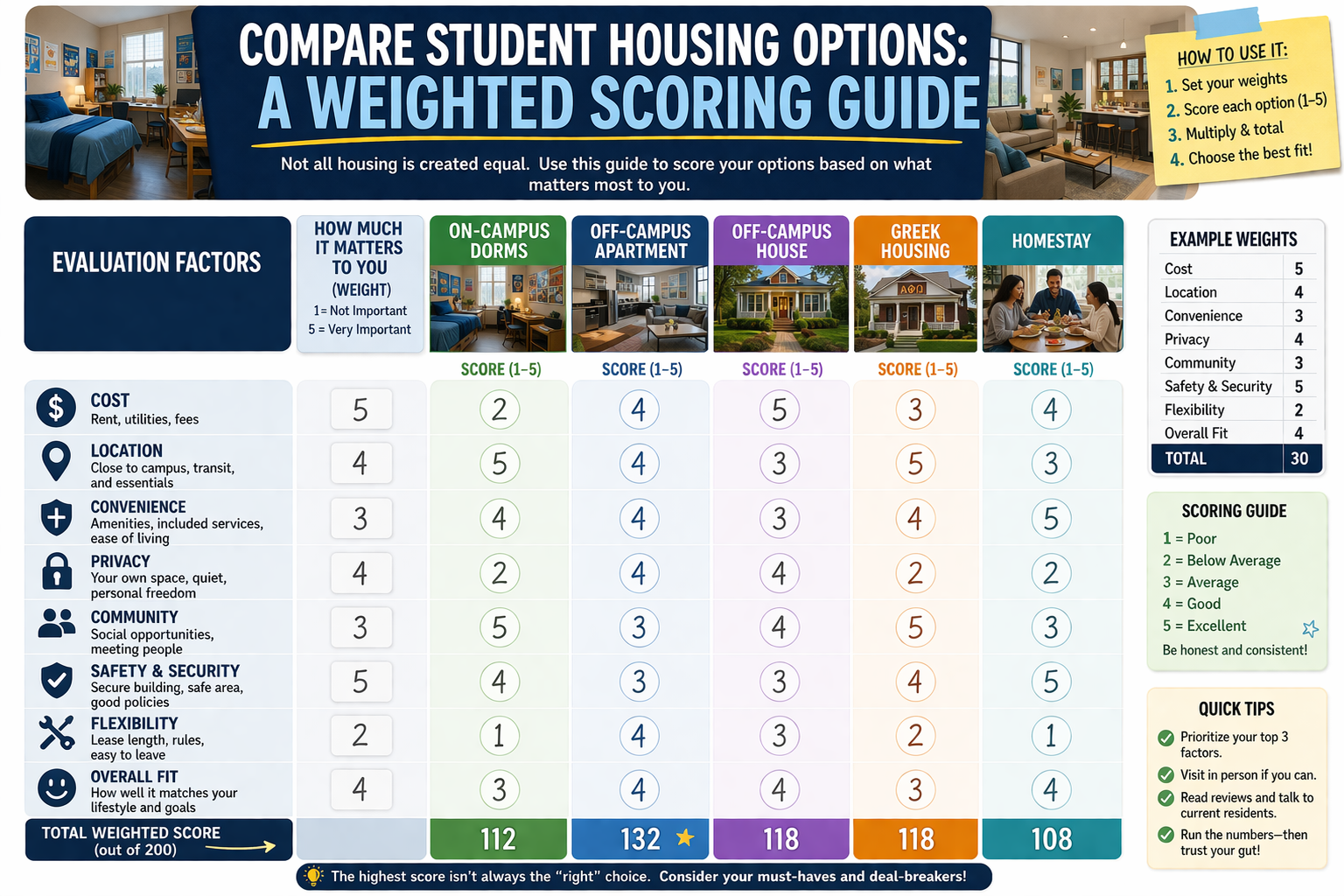
Comparing student housing options without a consistent system means you are not actually comparing the same things across properties. You toured four apartments. Two felt good. One was cheaper but farther from campus. One was closer but the landlord gave vague answers about maintenance. Now you are deciding based on a mix of impressions, half-remembered details, and whichever tour happened most recently. This guide gives you a structured, repeatable system to evaluate every option against the same criteria — so your final decision reflects actual analysis.
TL;DR: How to Compare Student Housing Options
- Use six weighted categories: total true cost, commute, management quality, unit condition, lease terms, and safety.
- Score each property 1 to 5 in each category, multiply by the category weight, and sum for a weighted total out of 5.0.
- Adjust category weights before you start based on your personal priorities — do not change them mid-comparison.
- Use Find My Place reviews to pre-score management quality for every property before scheduling a single tour.
- A weighted score above 4.0 indicates a genuinely strong option. Below 3.0 signals meaningful weaknesses that will affect your daily experience.
Why Informal Comparison Fails
Properties are actively marketed to feel good during tours. Leasing agents are trained to redirect attention from weaknesses. Model units are not the units you will actually live in. Without a system that forces you to gather the same information from every property, you are making a decision based on marketing — not on what the housing will actually be like for 12 months.
The most common phrases students use to describe how they chose their apartment: “it just felt right,” “the price was good,” “I liked the layout.” These are valid inputs. They are not a complete evaluation system.
The Six Weighted Categories
Each category measures a dimension of housing quality that students consistently identify as meaningful in satisfaction surveys and peer reviews on Find My Place. Default weights are based on national student housing preference data. Adjust them before you begin based on your specific situation — then apply the same weights to every property you evaluate.
| Category | Default Weight |
| Total true cost | 25% |
| Location and commute | 25% |
| Management quality and maintenance | 20% |
| Unit condition and infrastructure | 15% |
| Lease terms and flexibility | 10% |
| Safety and neighborhood | 5% |
How to adjust weights: If you are on a tight budget, increase cost to 35% and reduce location to 15%. If you are car-free in a cold climate, increase location to 35% and reduce safety (proximity to campus already reduces that risk). If you have had bad landlord experiences, increase management to 30%. The system works as long as you apply the same weights across all options.
How to Score Each Category
Total True Cost (default 25%)
Calculate the all-in monthly cost for each property: base rent plus utilities, internet, parking, renter’s insurance, and any mandatory fees. Divide upfront costs (application fees, security deposit) across your lease term and add that monthly figure too. Then score relative to your budget ceiling.
| True Monthly Cost vs. Budget | Score |
| 10%+ below budget | 5 |
| Within 5% of budget | 4 |
| At your budget ceiling | 3 |
| 5-10% above budget | 2 |
| More than 10% above budget | 1 |
One comparison trap to avoid: a unit at $650 per month with utilities and Wi-Fi included often costs less than a unit at $600 with none of those inclusions. Advertised rent is a starting number. True cost is what you are actually scoring.
Location and Commute (default 25%)
Score based on the commute time you actually tested — not a Google Maps estimate. Walk or ride the route at the time of day you would realistically do it.
| Actual Commute to Campus | Score |
| Under 10 minutes walking | 5 |
| 10-15 minutes walking or cycling | 4 |
| 15-20 minutes or a direct bus route | 3 |
| 20-30 minutes requiring a transit connection | 2 |
| Over 30 minutes or unreliable transit | 1 |
Location scores matter more than their 25% weight suggests because commute compounds daily. A 25-minute commute means roughly 300 hours per academic year in transit. At student wage rates of $15 to $20 per hour, that is $4,500 to $6,000 in time cost annually — a figure worth factoring into any apparent savings a farther unit offers.
Management Quality and Maintenance (default 20%)
Management quality is invisible in listing photos. Read Find My Place reviews for each property before touring — filter specifically for comments about work orders, response times, and how problems were handled. A pattern across multiple reviews is more informative than any single rating.
| Management Evidence | Score |
| Consistently positive reviews, specific response time stated, clear maintenance system | 5 |
| Mostly positive reviews, responsive communication during tour | 4 |
| Mixed reviews, adequate tour answers but no response time specifics | 3 |
| Negative maintenance patterns in reviews, vague answers during tour | 2 |
| Multiple recent negative reviews, evasive responses | 1 |
Ask the landlord directly how maintenance requests are submitted. A specific, confident answer (“through our app, non-emergency response within 48 hours”) indicates an established system. “Just call the office” signals what your experience will be after move-in.
Unit Condition and Infrastructure (default 15%)
Score based on direct physical inspection during the tour.
| Physical Condition Observed | Score |
| No issues found, all fixtures functional, no water damage, modern HVAC | 5 |
| Minor cosmetic issues only, all functional elements working | 4 |
| One or two fixable issues landlord has agreed to address before move-in | 3 |
| Multiple issues present, resolution unclear | 2 |
| Water damage evidence, broken fixtures, apparent deferred maintenance | 1 |
Check ceiling corners, walls near windows, areas under sinks, and bathroom bases for water staining. Test every fixture. Ask when the HVAC was last serviced — in Sun Belt markets like Arizona and Nevada, a failing AC unit in August is a habitability issue, not a minor inconvenience. Ask whether included Wi-Fi is a dedicated unit connection or a shared building network. A shared network degrades under simultaneous load during peak evening hours, exactly when students need it most.
Lease Terms and Flexibility (default 10%)
| Lease Flexibility | Score |
| By-the-bed lease, early termination clause, subletting permitted | 5 |
| By-the-bed lease OR clear early termination option | 4 |
| Joint lease with early termination clause and reasonable fee | 3 |
| Joint lease, early termination possible but expensive or unclear | 2 |
| Joint lease, no early termination, subletting prohibited | 1 |
On a joint lease, all tenants share financial liability. If a roommate stops paying, their share becomes your legal problem. A by-the-bed lease limits your responsibility to your own room only. If you need to exit a lease mid-year, Find My Place lease transfer marketplace connects students who need out with students who need in — but only if the original lease permits assignment or subletting.
Safety and Neighborhood (default 5%)
| Safety Assessment | Score |
| Comfortable walking alone at night, good lighting, low crime data, security features present | 5 |
| Generally comfortable, adequate lighting, no specific concerns | 4 |
| Some caution warranted at night, manageable with awareness | 3 |
| Uncomfortable at night, poor lighting, current resident concerns noted | 2 |
| Active safety concerns, multiple recent incidents noted | 1 |
Walk the route from the unit to campus in the evening before you score this category — not during a daytime tour. Check the city’s public crime mapping tool for the specific address and compare it to the area around campus. The benchmark is not “is there any crime” but “is this meaningfully different from where I already spend my days.”
Calculating Your Weighted Score
For each property, multiply each category score by its weight and sum the results.
- Cost score x 0.25
- Location score x 0.25
- Management score x 0.20
- Unit condition score x 0.15
- Lease terms score x 0.10
- Safety score x 0.05
- Total weighted score (max 5.0)
A score above 4.0 indicates a genuinely strong option across multiple categories. A score below 3.0 signals weaknesses that will affect your daily experience over 12 months.
When the Scores Are Close
If your top two options score within 0.3 points of each other, the system has done its job — it has narrowed the field to genuinely comparable options. At that point, use your personal priorities to break the tie. If location matters most to you, the location score decides it. If management has burned you before, weight that score more heavily in your thinking.
The highest score is not automatically the right choice. A property scoring 4.2 with a commute you tested and can live with beats a property scoring 4.4 with a commute that looked fine in February but will cost you in January. The system gives you grounded information. The final call is still yours.
Start With Reviews, Not Tours
Use Find My Place verified peer reviews to pre-score management quality for every property on your shortlist before you schedule a single tour. Students who have already lived there have done part of this evaluation for you. Five minutes of reading before your first showing gives you a working score for the category that is both hardest to assess in person and most consequential after move-in.
