
Dorms vs. Off-Campus Housing: How College Students Decide
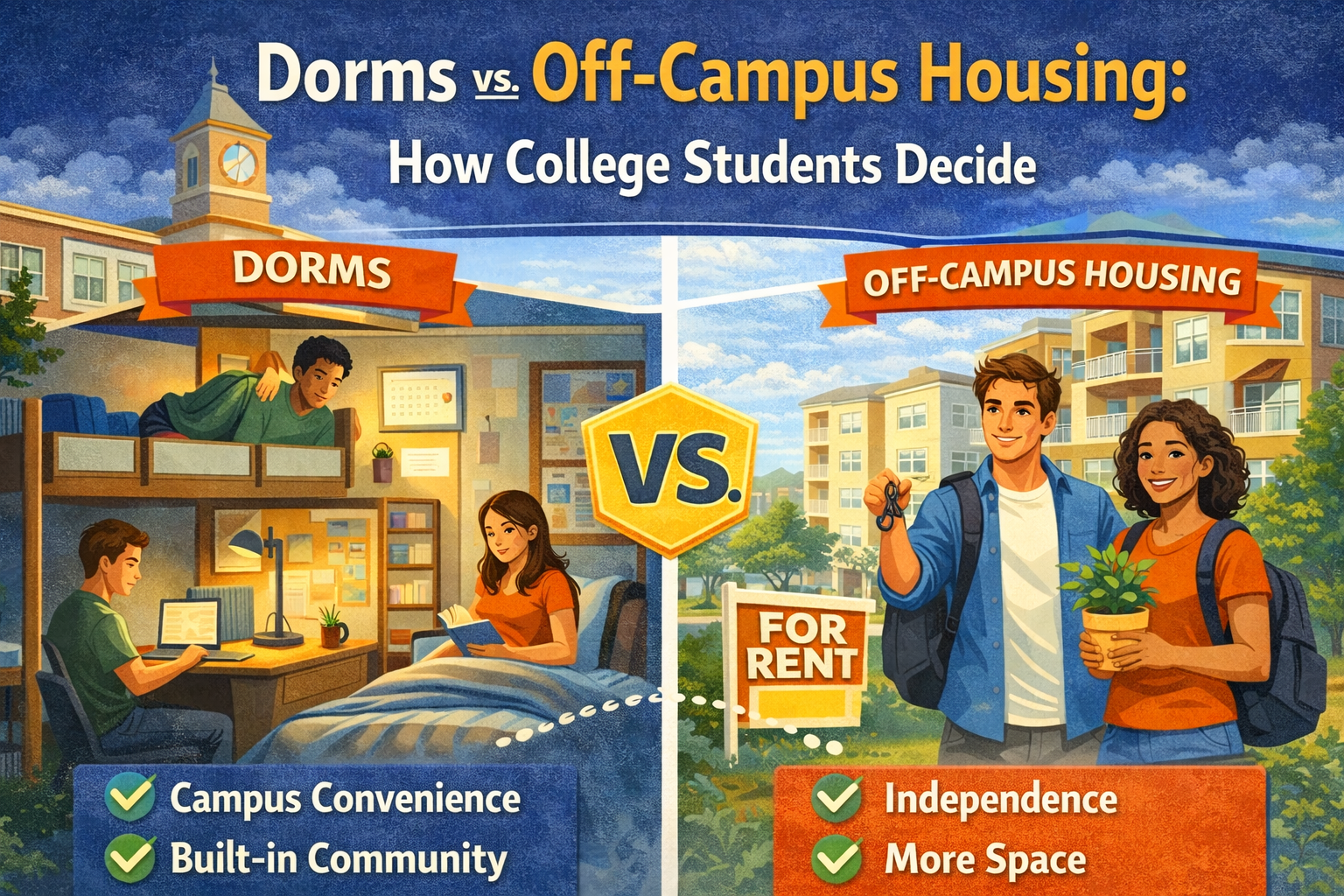
Neither dorms nor off-campus apartments are objectively better. Your year in school, budget, social situation, and what you actually need from a housing arrangement all determine which option fits. Getting it wrong has real consequences: financially, socially, and for your academic performance.
Sixty-two percent of university students nationally live off campus but not with family, making off-campus housing the majority experience by sophomore year. But that statistic doesn’t mean off-campus is right for you at your specific stage. Use this framework to make the call with accurate information rather than assumptions.
TL;DR: Quick Answer
- Dorms typically make sense for first-year students without an established social network and for students whose financial aid is packaged specifically for on-campus room and board.
- Off-campus apartments cost less per person in most mid-size college towns when you split a unit with two or three roommates, but the all-in cost comparison is closer than advertised rents suggest.
- Privacy, space, and lease flexibility favor off-campus housing clearly; built-in community and simplified logistics favor dorms.
- Most students do well living on campus for year one, then evaluating off-campus for years two through four.
- Find My Place lists verified off-campus housing by university with peer reviews that show what properties actually cost to live in, not just what they advertise.
Cost: The Number Everyone Compares Wrong
Comparing a dorm’s advertised rate to an apartment’s listed rent is the most common mistake students make. Those numbers don’t measure the same thing.
A dorm at $7,200 per academic year includes your bed, furniture, all utilities, Wi-Fi, maintenance, and a meal plan. An apartment listed at $600 per month includes the room and nothing else. Add utilities ($100 to $200 per month), internet ($15 to $40 per person), renter’s insurance ($10 to $20 per month), and groceries to replace the meal plan ($250 to $400 per month), and a $600 apartment costs $975 to $1,200 per person all-in monthly. That’s $8,775 to $10,800 over a nine-month academic year.
A 2025 NMHC/Axiometrics study found that when controlling for amenities and proximity, students in traditional dorms pay roughly 9 percent more per equivalent housing unit than students in comparable purpose-built off-campus apartments. Dorm sticker prices often appear lower, but the value per dollar frequently favors off-campus options for students with roommates.
Worth noting: the exceptions are real. In high-cost metros like Boston, Los Angeles, or San Francisco, off-campus rent with roommates can still exceed dorm all-in costs. Aid packages structured specifically for on-campus room and board may not transfer, so verify before assuming off-campus saves money. And schools with mandatory first-year residency remove the decision entirely for freshmen.
Cost verdict by situation:
| Scenario | Likely cheaper | Why |
| Freshman with aid covering on-campus room and board | Dorms | Aid may not transfer to off-campus |
| Sophomore+ with 2-3 roommates in a mid-size college town | Off-campus | Roommate split drops per-person cost below most dorm rates |
| Student in a high-cost coastal city | Evaluate carefully | Off-campus rents in Boston, LA, NYC can exceed dorm all-in |
| Mountain West or Southwest university market | Off-campus | Private rooms in purpose-built student housing often run $200 to $400 less than dorm rates |
Social Life: The Dorm Advantage Is Real but Time-Limited
Every honest comparison has to acknowledge this: for students who arrive at college without knowing many people, dorms provide a social infrastructure no apartment can replicate. Floor events, shared bathroom conversations, study groups that form in common rooms, these happen automatically in residence halls. They don’t happen automatically in apartments.
In a 2025 StarRez survey of 418 institutions, roughly one-third of students who reported high housing satisfaction specifically cited their sense of community as the reason. Building that community is meaningfully harder in an apartment complex where you may barely know your neighbors.
Year one is when the dorm advantage is sharpest; it diminishes quickly by year two. Students who move off campus as sophomores or juniors, after building social networks through classes and campus organizations, report social experiences on par with on-campus peers. Higher degree completion rates among on-campus residents are largely attributed to first-year transition support, not to dorm life as a lasting advantage.
Social verdict: Choose dorms if you’re an incoming freshman without an existing social network or if structured social opportunities matter to you. Choose off-campus if you’re a returning student with an established friend group or if you prioritize the ability to decompress away from campus noise.
Privacy and Space: Off-Campus Wins Clearly
Dorms are unambiguously smaller and less private than off-campus apartments. A 2025 StarRez survey found 51 percent of students rank single rooms as their top priority in on-campus housing applications. Most public universities can’t provide them. Shared rooms with random roommate assignments remain the default for freshmen at most schools.
Off-campus, the standard configuration is a private bedroom in a shared four-bedroom unit: a lockable personal space, a shared kitchen, and roommates you actually chose. Students in this setup report higher satisfaction with their personal space than on-campus counterparts, even when the per-person square footage is comparable.
For students whose studying requires quiet, privacy, or a dedicated workspace, that gap is not minor.
Practical Logistics: Where Dorms Have Genuine Advantages
Three operational advantages of dorms are worth acknowledging:
Maintenance. Submit a work order and it gets handled. Off-campus, responsiveness varies widely by landlord. Slow maintenance response is the single most common complaint in student housing reviews. Purpose-built student apartment communities have narrowed this gap, but privately managed student rentals still show significant variation.
Safety and security. Most residence halls have 24/7 desk staff, card-access entry, and on-site resident advisors. These features matter, especially for students new to living away from home.
No lease complexity. A dorm license agreement is far simpler than a residential lease. You’re not responsible for utilities, maintenance coordination, or the financial consequences of a broken lease. For a first-time renter navigating everything else that comes with starting college, that reduced administrative load has real value.
These advantages matter most for freshmen. By sophomore year, most students have enough experience to handle off-campus logistics without the learning curve.
Flexibility: Off-Campus Has a Clear Edge for Non-Traditional Situations
Dorm contracts are structured for the academic year and carry penalties for early exit. If plans change mid-year because you transfer, take a leave, or land an off-campus internship, the exit process is bureaucratic and often expensive.
Off-campus leases have their own exit challenges, but the options are wider. A lease transfer through a contract marketplace gives students who need to leave early a structured path that avoids paying double rent. By-the-bed lease arrangements limit your liability to your own bedroom: if a roommate transfers or drops out mid-year, their departure doesn’t become your financial problem.
Transfer students, graduate students, international students, and anyone whose academic timeline doesn’t follow a standard September-to-May pattern will find off-campus housing offers structural flexibility that dorm contracts can’t match.
The Decision Framework
| Your situation | Recommended choice | Primary reason |
| Incoming freshman, no established social network | Dorms (year one) | Built-in community accelerates the transition to college life |
| Sophomore+ with an existing friend group | Off-campus | Social advantage of dorms has diminished; cost and space benefits of apartments are clear |
| Budget is the primary constraint | Off-campus with 3-4 roommates | Roommate split produces lower per-person cost than most dorm rates |
| Financial aid covers on-campus room and board | Dorms | Verify before assuming aid transfers to off-campus |
| Privacy and personal space are essential | Off-campus, private bedroom | Dorms structurally cannot offer comparable private space at most schools |
| Transfer, graduate, or non-traditional student | Off-campus | Flexible lease terms better match non-standard academic timelines |
| High-cost metro (NYC, Boston, LA) | Evaluate carefully | Off-campus costs in these markets can exceed dorm all-in costs |
The Bottom Line
One hybrid approach holds up across most student situations: live on campus for your first year, then move off campus for the remaining years. Year one captures the genuine community and transition support advantages of dorms. Years two through four, the cost and space benefits of off-campus housing compound without the social trade-off that worried you as a freshman.
When you’re ready to evaluate off-campus options, peer reviews from current residents matter more than advertised rents. Reviews tell you what management is actually like to work with, what utilities actually cost monthly, and whether the social environment at a specific complex fits what you’re looking for. Find My Place listings include verified peer reviews by university market, which gives you that ground-level picture before you tour or apply.
