
Dorms vs. Off-Campus Housing: The Decision Framework Every Student Should Use
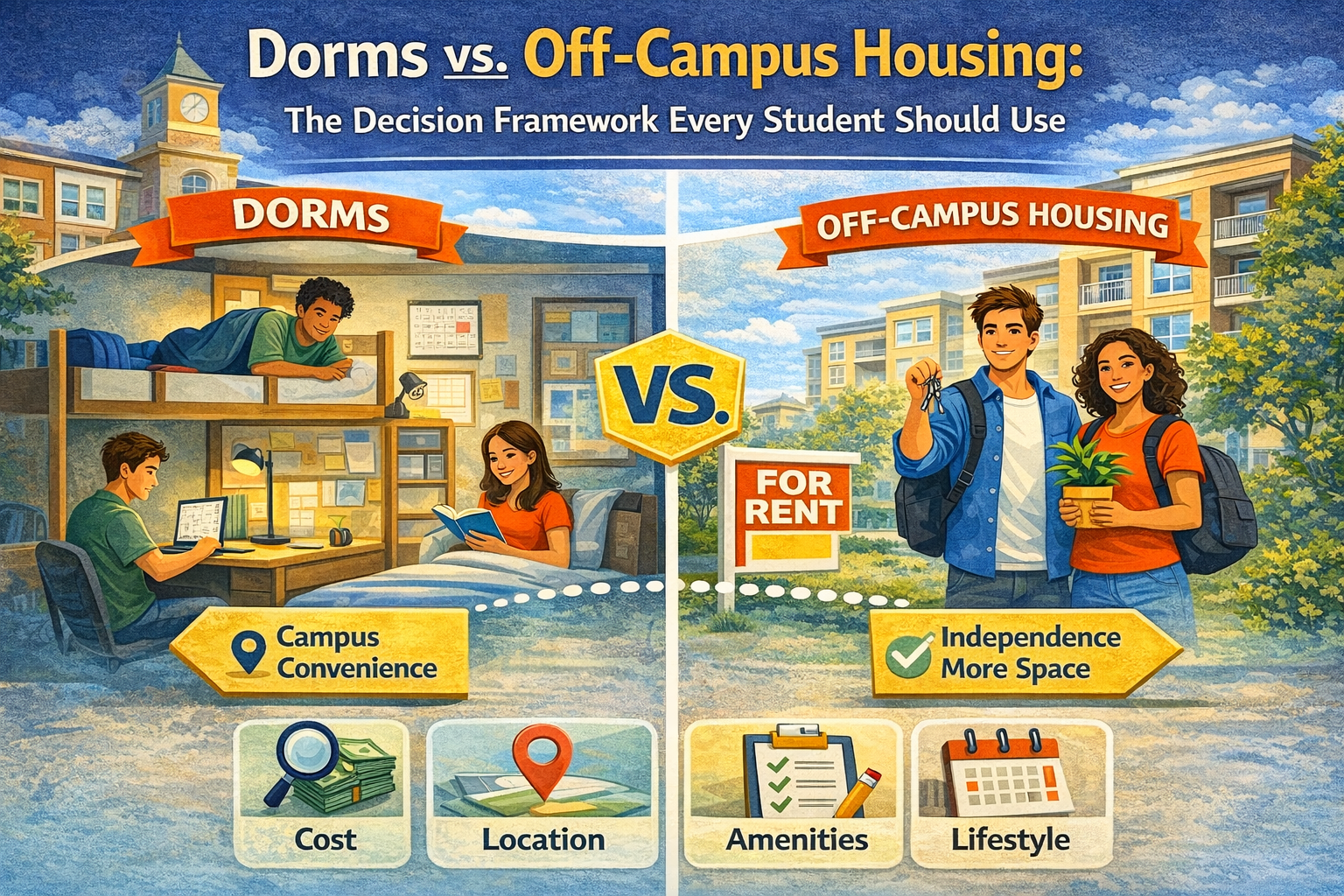
The dorms versus off-campus decision has a right answer but it’s personal, not universal. The same choice that sets one student up socially and academically can leave another financially strained or isolated. Most comparisons lead with broad arguments about cost or community when the real question is which factors matter most for your specific situation right now.
Research from the University of Oregon tracking 75,000 students across eight cohorts found that first-time freshmen who lived on campus their first year graduated at rates 8 percentage points higher than peers who didn’t, and finished roughly one full academic term faster. That advantage is real. What the same research cannot tell you is whether it applies to a returning sophomore who already has a social network, or a transfer student whose timeline doesn’t align with a standard 12-month lease, or a student in a high-cost city where dorm rates are genuinely lower than off-campus alternatives.
TL;DR: Quick Answer
- First-year students with no established social network benefit most from dorms. The academic and social advantages are real and well-documented for that specific group.
- From sophomore year onward, off-campus housing typically offers better cost-per-square-foot, more privacy, and lease flexibility that dorms structurally can’t match.
- Dorms average $14,544 per year including a meal plan. Off-campus averages $11,983 for housing and food combined at public four-year institutions but that gap narrows significantly when you add utilities, internet, and transportation.
- Run the actual all-in numbers for both options before deciding. Dorm sticker prices and apartment advertised rents are not equivalent units of measurement.
- Find My Place’s peer reviews give you the property-level detail maintenance response, real utility costs, management reliability that no leasing brochure includes.
Factor 1: Cost Run the Full Numbers, Not the Headline Numbers
The most common error in this comparison is treating advertised dorm rates and listed apartment rents as equivalent. They measure different bundles of services.
A dorm at $7,200 per academic year includes your bed, furniture, all utilities, Wi-Fi, building maintenance, and typically a required meal plan. An apartment listed at $700 per month includes your room. Add utilities ($100-$200/month), internet ($15-$40/person), renter’s insurance ($10-$20/month), groceries to replace the meal plan ($250-$400/month), and transportation if needed and a $700 apartment frequently costs $1,200-$1,400 per person per month all-in, or $10,800-$12,600 over nine months.
For 2025-2026, U.S. News found the average on-campus food and housing cost across 1,027 institutions was $14,544 per year, including the meal plan. Off-campus students at public four-year institutions paid an average of $11,983 for housing and food combined, according to NCES data. The gap is smaller than it appears when both numbers include equivalent services.
When dorms are genuinely cheaper:
In high-cost metro markets New York City, Boston, Los Angeles, San Francisco off-campus rent for a private room can exceed $1,500-$2,500 per person monthly. Dorm bundled costs may actually be lower than realistic off-campus totals in those markets. Some financial aid packages are specifically structured for on-campus room and board and may not transfer to off-campus use. Verify with your financial aid office before assuming aid applies equally to both options. Students who use dining halls for most meals are paying for something they’d spend on anyway. Those who rarely use dining halls are subsidizing a service they don’t consume.
When off-campus is genuinely cheaper:
In mid-size university markets Provo, Tempe, Boise, Fort Collins, Boulder a private bedroom in a four-person off-campus apartment typically runs $550-$950 per person per month all-in. NMHC/Axiometrics research found that students in traditional on-campus dorms often pay a 9 percent premium per equivalent housing unit compared to comparable off-campus purpose-built apartments. Dorm sticker prices look lower; value per dollar frequently favors off-campus options.
Factor 2: Academic Performance What the Research Actually Shows
Multiple peer-reviewed studies confirm that first-year students who live on campus achieve higher GPAs, return for sophomore year at higher rates, and graduate faster than off-campus peers. The University of Oregon study is the most methodologically rigorous available, controlling for race, parental education, and finances across eight cohorts.
On-campus freshmen scored an average of 0.13 GPA points higher in their first year, returned for sophomore year at rates 5 percentage points higher, and graduated at rates 8 percentage points higher over six years. These differences are real.
What the research doesn’t show: whether this advantage persists for returning students; whether it applies equally across income levels (separate research suggests the benefit is strongest for lower-income students gaining access to campus resources they’d otherwise pay for); or whether the advantage comes from on-campus living itself versus the characteristics of students who choose it.
The academic environment matters more than location alone. A 2024 GCU/GCE survey of 1,003 college students found that 1 in 6 dorm residents reported their housing was not supportive of their academic work the highest dissatisfaction rate among all housing types surveyed. Off-campus apartments and on-campus apartments both scored higher on academic environment satisfaction than traditional dorms. The most likely explanation: private bedrooms with lockable doors create the controlled study environment that shared dorm rooms structurally cannot provide. A 2025 StarRez survey of 418 institutions found 51 percent of students rank single rooms as their top preference a demand most schools can’t come close to meeting.
Factor 3: Social Life and Transition Support
Dorms hold their clearest advantage here, and it’s most pronounced exactly when it matters most: the first year. Residence halls create social infrastructure automatically. Floor events, shared bathrooms that become unexpected connection points, study groups forming in common rooms, RAs organizing programming these mechanisms generate relationships without requiring students to seek them out. For a student arriving where they know no one, that automatic community is genuinely valuable.
Research consistently links on-campus living with stronger feelings of campus belonging and higher participation in extracurriculars during the first year. The social benefit of dorm life is real for that group.
The honest caveat: this advantage is primarily a first-year phenomenon. The University of Oregon data shows the GPA gap between on- and off-campus students narrows by year two and closes by year four. Students who have already built their social network returning students, transfers with established connections report social experiences comparable to on-campus peers when living off-campus. Students who are naturally more introverted benefit more from structured dorm social environments than students who actively seek out social settings on their own.
Factor 4: Practical Logistics
Where dorms have a genuine edge:
Maintenance in dorms requires no landlord management: submit a request, it gets handled. Off-campus maintenance quality varies considerably by property, and slow maintenance response is the single most common complaint in student housing reviews. Dorm housing contracts are also far simpler than residential leases no security deposit disputes, no utility accounts to set up, no lease assignment clauses to understand. Most residence halls include 24/7 desk staffing, card-access entry, and on-site RAs. Purpose-built student apartment complexes increasingly match these safety features, but private landlords and smaller rentals vary.
Where off-campus has an equal edge:
Transfer students, international students, students doing co-ops or internships, and graduate students all benefit from off-campus options that accommodate non-September-to-May calendars. By-the-bed leases and contract resale platforms including Find My Place contract marketplace provide exit options that dorm contracts don’t. Managing utilities, maintaining a household, and navigating a landlord relationship are also skills that matter after graduation. Students who develop them earlier arrive at independence better prepared. Setting your own thermostat, choosing your roommates, and having guests without curfews are genuine quality-of-life factors that students consistently cite when explaining their preference for off-campus living.
Decision Framework: Match Your Situation to the Right Option
| Your Situation | Recommended Option | Primary Reason |
| Incoming freshman, no established social network | Dorms (year one) | Automatic community addresses the hardest part of the transition |
| Sophomore or junior with an established friend group | Off-campus | Social dorm advantage has diminished; cost and space benefit is clear |
| Financial aid structured specifically for on-campus housing | Dorms | Aid may not transfer; use what’s already covered |
| Attending school in a mid-size market with a budget constraint | Off-campus with 2-3 roommates | Roommate split produces lower per-person cost than most dorm all-in rates |
| High-cost coastal city (NYC, Boston, LA, SF) | Evaluate carefully | Off-campus costs in these markets may match or exceed dorm all-in rates |
| Transfer, graduate, or non-traditional student | Off-campus | Flexible lease terms better match non-standard academic timelines |
| Strong need for private, quiet study environment | Off-campus with private bedroom | Dorms structurally can’t deliver comparable private study space at most schools |
The Verdict: Year One On-Campus, Years Two Through Four Your Call
The data most consistently supports a hybrid approach: on-campus for the first year, off-campus from sophomore year onward. The first-year advantages of dorms automatic community, simplified logistics, and the documented academic retention effect are most pronounced when students are most vulnerable to dropping out. The ongoing cost and space disadvantages of dorms compound over four years.
If you’re a returning student moving off-campus, Find My Place’s verified listings and peer reviews give you property-level detail that no general rental site can match. Read what students say about management responsiveness, real utility costs, and the living environment before you tour.
