
Student Apartment Move-In Checklist: 9 Steps Before You Sign
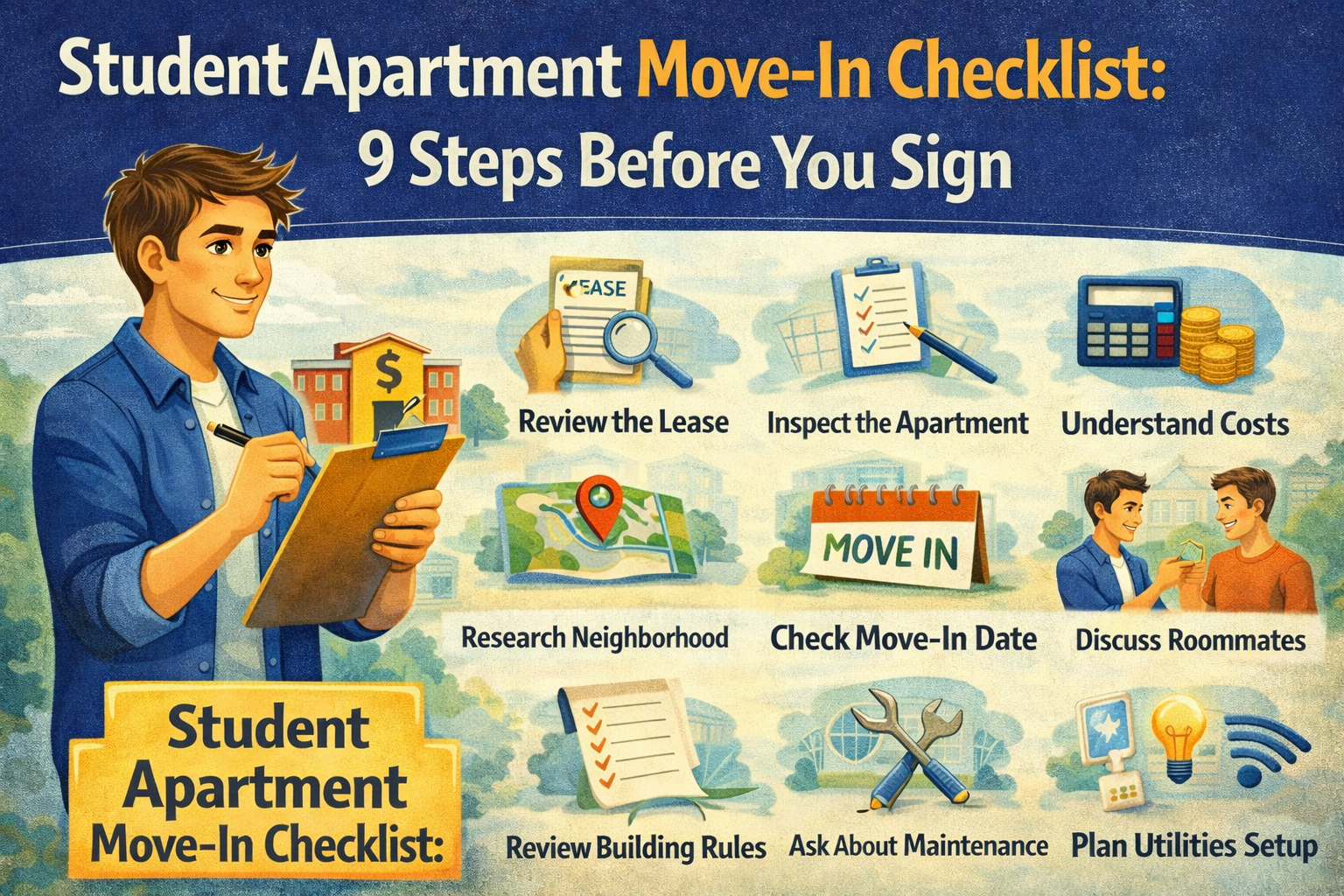
Nine steps stand between you and a lease you’ll regret. Skipping any of them doesn’t just create inconvenience – it creates financial exposure: lost security deposits, hidden monthly fees, locked-in renewals, and maintenance battles with no leverage. This checklist covers every step in the order it matters, starting with the highest-stakes item most students skip entirely.
TL;DR: What This Checklist Covers
- The lease addendum – not the rent page – is where hidden fees of $100 to $400 per month are buried. Read it before signing anything.
- Student-specific reviews on Find My Place surface management quality, fee accuracy, and photo-versus-reality gaps that Google ratings don’t show.
- Your real monthly cost is base rent plus every mandatory fee plus utilities. Calculate this before comparing any two units.
- Sublease rights, auto-renewal opt-out deadlines, and utility inclusions must be confirmed in writing – verbal assurances are unenforceable.
- Testing appliances and management response time before signing gives you the leverage and information you lose the moment you hand over a deposit.
Step 1: Read Every Fee Line in the Lease Addendum – Not Just the Rent Page
Financial exposure: $100–$400 per month above advertised rent
The advertised rent is not what you will pay. The difference lives in the lease addendum – a document attached to the back of the lease that first-time renters rarely look for. By 2025, landlords have begun charging separately for services previously bundled into rent: trash collection, pest control, parking, smart home technology packages, package locker services, and amenity access fees. Students who used Find My Place have documented paying $200 to $400 per month more than the headline price they were originally quoted.
This earns the first spot because it’s the most financially damaging step to skip and the easiest to fix. Request a full written fee schedule before your tour – not after. Add every mandatory monthly line item to the base rent. That total is your real monthly cost.
What to confirm before signing:
- Ask for the fee schedule in writing. A legitimate property sends it without hesitation. If they won’t provide it before signing, treat that the same way you would a restaurant that won’t show you the menu before seating you.
- Identify which fees are mandatory versus optional. Amenity fees for a gym you won’t use are often non-negotiable – confirm this before assuming you can waive them.
- Cross-check against Find My Place reviews for that property. Students who lived there name specific fees by line item. If a review mentions a $75 “community fee” not in your quote, ask the leasing office to account for it before you sign.
Step 2: Check Student Reviews – Not Just the Google Star Rating
Exposure: Signing with a management team that won’t answer the phone after move-in
A 4.2-star rating on Google tells you nothing about whether the heat works in January. Student-specific reviews on Find My Place filter for the things that matter to students specifically: management responsiveness, whether the photos matched the actual unit, noise levels, lease flexibility, and maintenance turnaround. About 69% of renters check reviews before choosing housing, but most check the wrong reviews – platforms that aggregate feedback from families and professionals whose priorities don’t map onto yours.
One five-star review about updated appliances is useful to someone. It’s not useful to you if your real concern is whether maintenance fixes a broken AC unit in August without a three-week wait.
What to check before touring:
- Search the property on findmyplace.co before your tour. Read the most recent reviews first. Management quality changes when ownership or leasing staff turns over.
- Look specifically for mentions of maintenance response time. It’s the single most predictive factor for whether your lease year is livable.
- Three reviews citing the same problem are a reliable pattern. One bad review is an outlier. Three reviews mentioning the same hidden fee, the same slow repairs, or the same gap between photos and reality are a signal worth acting on.
Step 3: Calculate Your True Monthly Cost Before Comparing Units
Exposure: Choosing the cheaper-looking apartment that actually costs more
Here is a comparison most students make: Unit A is listed at $950, Unit B at $1,050. Unit A looks like the obvious choice. But Unit A carries $180 in mandatory monthly fees and doesn’t include water. Unit B’s advertised price covers all utilities with no add-on fees. The real comparison is $1,130 versus $1,050. Without this calculation, you pick the more expensive apartment while believing you chose the cheaper one.
Most housing searches compare headline rent figures because that’s what listing platforms display prominently. Move-in costs compound the problem: application fees, first and last month’s rent, and utility deposits are separate from rent and rarely appear in the listing price.
What to calculate before committing:
- Build a comparison sheet with identical line items for every unit you’re evaluating: base rent, mandatory fees, estimated utilities if not included, parking, and one-time move-in charges.
- Ask directly: “What is my total move-in cost, and what will I pay all-in each month?” That answer – not the listed rent – determines whether you can afford this property right now.
- Find My Place reviews frequently include all-in monthly costs from current or former residents. Use those figures as a reality check before you tour.
Step 4: Confirm Sublease and Lease Transfer Rights in Writing Before Signing
Exposure: Trapped in a lease you cannot exit without financial penalty
Study abroad decisions, graduate school acceptances, and internships that relocate you mid-lease are not edge cases – they are predictable life events in a college student’s timeline. Whether you can exit a lease without owing the remaining term depends entirely on whether your lease permits subletting or contract transfer, and many student leases quietly prohibit both.
Tenant protections vary by state. Some states require landlords to consider written sublease requests; others do not. A lease that prohibits subletting in a state with limited tenant protections leaves you with two options: pay the early termination fee or keep paying for an apartment you’re not living in. Find My Place operates a lease transfer marketplace, but that marketplace only helps you if your lease permits using it.
What to confirm before signing:
- Find the sublease clause before anything else. Look for “subletting,” “assignment,” or “lease transfer” in the lease body. If the clause prohibits it outright, ask the property to add a written addendum permitting student contract transfers as a condition of signing.
- Ask the leasing agent directly: “Can I list my contract for transfer on a student platform if I need to leave?” A cooperative answer in writing is your protection. Vagueness is your warning.
- Know the early termination fee as your worst-case number. If subletting is blocked and you need to break the lease, that fee is what you’ll pay. Know it before you sign, not when you need it.
Step 5: Photograph Every Room Before Unpacking a Single Box
Exposure: $1,000–$2,000 security deposit that doesn’t come back
Security deposits average one to two months’ rent. Getting that money back at move-out depends almost entirely on your ability to prove that damage you didn’t cause was already present when you arrived. Without timestamped documentation, it’s your word against the property’s – and the property holds the deposit.
Move-in day is chaotic, and photographing scuffs and scratches feels tedious when you’re carrying boxes. That’s exactly why so many students skip it and spend the rest of the lease year unable to recover money they’re owed.
What to document on move-in day:
- Photograph every wall, floor, ceiling, appliance, and fixture before you touch a box. Use your phone’s timestamp feature – the metadata proves when the photos were taken.
- Email the photos to yourself and the leasing office on move-in day. A sent email creates a timestamped record the property has acknowledged receiving.
- Request a written move-in inspection form from management. If the property doesn’t offer one, your photo record is your fallback and your protection.
Step 6: Verify Utility Responsibilities in Writing – Verbal Promises Don’t Count
Exposure: $150 or more per month in unexpected bills
“Water is included.” “Internet comes with the unit.” “Trash is covered.” These are the three most common verbal assurances that disappear between the tour and the lease. When the first utility bill arrives and you call to dispute it, the leasing team has no record of what was said during your walk-through.
Leases should specify which utilities each party is responsible for, but many don’t, or use vague language that favors the landlord when challenged. Landlords now commonly charge separately for services previously bundled – internet as a monthly “technology fee,” trash as a separate service charge – making utility verification more important than it was five years ago.
What to get in writing before signing:
- For every utility the leasing agent says is included, point to the lease and ask them to show you where it says so. If it isn’t there, ask for a written addendum before signing.
- Request historical average utility costs from the property management company. Providers for the area can also give you average monthly bills for that building.
- Clarify internet specifically. “High-speed internet as an amenity” and “internet included in rent” are not the same thing. Many complexes charge separately for internet as a mandatory monthly fee.
Step 7: Test Every Appliance and Fixture During the Tour
Exposure: Daily quality-of-life problems with no pre-signing documentation to back you up
Fresh paint and clean floors can hide an oven that doesn’t heat, a shower with inadequate water pressure, a dishwasher that doesn’t drain, and a bathroom without a working exhaust fan. These are the things that define daily life in an apartment. They are also the easiest things to hide behind a staged showing.
The tour is your only leverage window. Once you’ve signed and moved in, every non-working item becomes a maintenance request. Maintenance requests at properties with unresponsive management can sit for weeks. A five-minute test during the tour is worth more than months of follow-up.
What to test before you commit:
- Run every faucet. Check water pressure in the shower specifically – low pressure is a daily problem that no amount of new fixtures will hide once you’re living there.
- Turn on the oven and stovetop. If the leasing agent seems uncomfortable with you testing appliances, that discomfort tells you something.
- Check window and door seals for drafts. Poor door framing means higher heating and cooling costs every month – a cost that comes out of your pocket, not the landlord’s.
- Document anything that doesn’t work in writing on tour day. Send a note to the leasing office identifying the issue and ask for written confirmation it will be repaired before move-in.
Step 8: Find the Auto-Renewal Clause and Calendar the Opt-Out Deadline Immediately
Exposure: 12 months of unwanted rent
Auto-renewal clauses are the most expensive mistake students make at move-out, not move-in. They work like this: if you don’t provide written notice to vacate within a specific window before your lease end date – typically 30 to 60 days, though some properties require 90 – the lease renews automatically for a full term. No one calls to remind you. The window passes. You owe another year.
Getting the notice method wrong can invalidate your intent even when the timing is correct. Some leases require a written letter sent by certified mail; others accept an email; others require submission through a tenant portal. Sending a text to your leasing agent when the lease requires formal written notice doesn’t count.
What to do on the day you sign:
- Find the auto-renewal clause first. Search the lease for “renewal,” “automatic,” “notice to vacate,” or “holdover.” Read every sentence in that section.
- Calendar the opt-out deadline immediately. Set two reminders – one two weeks before the deadline, one on the deadline itself. Don’t rely on remembering this in 10 months.
- Confirm the required notice method in writing. Ask the leasing agent: “If I want to vacate at the end of my lease, what format does my notice need to take, and who does it go to?” Get that answer attached to your lease copy.
Step 9: Test Management Response Time Before You Commit – Their Speed Now Is Your Preview
Exposure: A year of unanswered maintenance requests
Before you sign, send the leasing office a specific question. Something about parking, about utility setup, about anything that requires a real answer. Then watch what happens. Do they respond the same day? The next morning? Three days later with a form reply? That pattern is your preview of what happens when your AC breaks in August and you need a response.
Ghost management is the most consistent ongoing complaint in student housing. The pattern is nearly always the same: attentive before signing, unreachable after. Management responsiveness outranks resort-style pools, fitness centers, and renovated kitchens as the factor that determines whether students are satisfied with their housing by the end of the lease year.
How to test this before signing:
- Send a specific pre-signing inquiry and clock the response. Something like, “I’m considering unit 204 – can you confirm whether covered parking is included or an add-on fee?” is specific enough to require a real answer.
- Call the maintenance line, not just the leasing line. Find out whether a human answers or whether you reach a voicemail routing to an unmonitored inbox.
- Read the most recent Find My Place reviews for that property and sort by newest. Students who finished their lease in the last six months describe management as it operates today – not as it operated when the 2021 five-star reviews were written.
Use This Checklist Before the Excitement Takes Over
Finding an apartment you want to live in is the easy part. The nine steps above are the part that determines whether that feeling survives contact with the lease. Students who skip this list don’t make bad decisions because they’re careless – they make them because no one told them what to verify before the adrenaline of signing made everything feel settled.
Find My Place combines student-written reviews, transparent listing data, and a contract transfer marketplace so you can cross-check every item on this list against what real students have already experienced at every property you’re considering. Use it before you tour. Use it again before you sign.
The best lease is the one you signed knowing exactly what you were committing to.
