
7 Student Housing Scams to Avoid Before You Sign
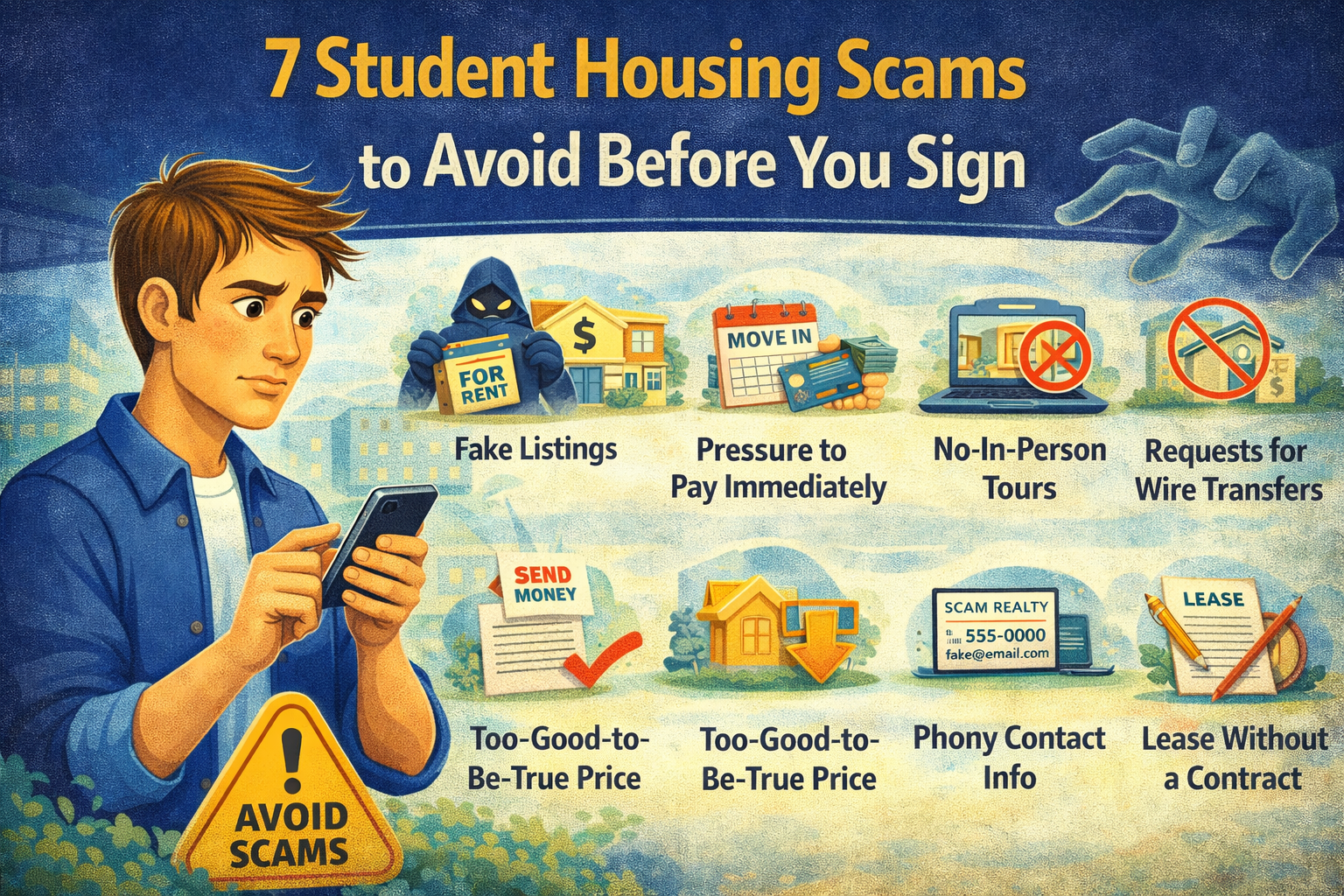
Rental scams target college students specifically, and the data shows it. People ages 18 to 29 were three times more likely than other adults to report losing money to rental fraud, with a median reported loss of $1,000 per incident – real money when you’re funding housing on student loans and part-time income. About half of those scams started with a fake ad on Facebook, where students naturally search for sublets and off-campus housing.
The seven scams below have all been reported by real college students. Knowing the pattern before you search is the only thing that prevents you from becoming the next report.
TL;DR: 7 Student Housing Scams Ranked by Damage
- The phantom landlord scam costs students the most per incident: a full deposit plus first month’s rent wired to someone you never meet.
- Stolen listing photos mimic real properties at lower prices – reverse image searching every photo takes 30 seconds and catches this before you pay anything.
- Hidden fee stacking is the most common ongoing scam: mandatory charges buried in the lease addendum add $100 to $400 per month above the advertised rent.
- Bait-and-switch pricing pulls you in with a lower-priced unit, then redirects you to a higher one after a non-refundable application fee is paid.
- The auto-renewal clause trap locks students into an unwanted additional year when the opt-out window passes unnoticed.
- Ghost management causes ongoing financial harm through unresolved maintenance that affects habitability – and it’s often detectable before you sign.
- The credit check enrollment trap is the lowest-damage scam on this list but targets students who don’t yet know that legitimate landlords run their own screening.
How These Scams Were Ranked
Each scam was assessed on three factors: frequency of reported incidents among college-age renters, average financial damage per incident, and how difficult the scam is to detect before money changes hands.
| Rank | Scam Type | Primary Red Flag | Damage Potential |
| #1 | Phantom landlord / fake listing | Wire transfer before viewing | High – full deposit + first month |
| #2 | Stolen listing photos | Price too low, urgency pressure | High – full deposit |
| #3 | Hidden fee stacking | No fee breakdown before signing | Medium – $100–$400/month ongoing |
| #4 | Bait-and-switch pricing | “That unit just rented” at signing | Medium – wasted application fees |
| #5 | Credit check enrollment trap | “Just $1” credit check link | Low-medium – recurring billing |
| #6 | Auto-renewal clause trap | No opt-out window mentioned | High – 12 months of unwanted rent |
| #7 | Ghost management | Fast responses before signing, silence after | Medium – maintenance costs, habitability |
Scam #1: The Phantom Landlord – Never Wire Money Before You’ve Seen the Unit
Damage potential: High – full deposit plus first month’s rent
A listing appears priced slightly below market, photos look good, and the landlord responds fast. The problem: the landlord is never available to show the unit in person. They’re traveling for work, overseas, or in the middle of a mission trip. They’ll send the keys once you wire the deposit.
This is the oldest rental scam in existence. It keeps working because the timing pressure is real – students searching in February or March feel the market shrinking. About half of people who reported a rental scam in the 12 months ending June 2025 traced it to a fake Facebook ad. Another 16% traced it to Craigslist. The FBI received reports in 2024 of $173 million in nationwide losses from rental fraud, and the phantom landlord pattern accounts for a disproportionate share of those numbers. The FBI’s guidance is direct: do not put money toward a property you have not personally seen.
How to spot it before you lose money:
- Any landlord who cannot show you the unit in person – ever – is a problem, not an inconvenience. Legitimate property owners find a way to show what they’re renting.
- Wire transfers, cryptocurrency, and payment apps like Venmo, Zelle, or CashApp are the preferred tools of rental scammers because they make recovery difficult or impossible. A credit card is the only payment method that carries consumer protection.
- The combination of below-market pricing and urgency language (“two other people are interested”) is the signature of a scam, not a motivated landlord.
Scam #2: Stolen Listing Photos – Reverse Image Search Before You Pay Anything
Damage potential: High – full deposit on a unit someone else already rents
The unit in the photos is real. The person renting it to you isn’t. Scammers copy photos from legitimate listings on Zillow, Apartments.com, or property management websites, swap in their own contact details, lower the price slightly, and repost on Facebook Marketplace or Craigslist. You pay a deposit on an apartment that either belongs to someone else or doesn’t exist as described.
The financial damage isn’t the only problem – it’s the timing. Students who fall for this scam often discover the truth days before their intended move-in date, leaving them scrambling for emergency housing. The pattern is consistent: scammers post exact photos from a real listing at a lower price, then push students to sign quickly before “another applicant” takes it.
How to spot it before you pay anything:
- Reverse image search every photo in the listing. Right-click any image and select “Search Image on Google.” If the same photos appear attached to a different address, a different landlord’s name, or a for-sale listing, walk away.
- Cross-check the address directly. If the same property appears at different prices with different contact information across platforms, or listed for sale rather than for rent, that’s a confirmed red flag.
- Verify ownership through the county assessor’s website. Property ownership is public record. If the name renting to you doesn’t match the owner on record, ask why before sending anything.
Scam #3: Hidden Fee Stacking – Demand the Full Fee Breakdown Before You Tour
Damage potential: Medium, ongoing – $100 to $400 per month above advertised rent
This is the most common scam on this list, and unlike the others, it isn’t technically illegal. The advertised rent is real. What isn’t disclosed are the mandatory charges buried in the lease addendum: admin fees, amenity fees, technology packages, pest control charges, package locker services, and trash valet programs you cannot opt out of. By the time you calculate what you’ll actually pay, the monthly cost is $200 to $400 above the price that got your attention.
Students on Find My Place describe being quoted $1,100 per month and paying $1,400 after mandatory add-ons. The damage here isn’t a one-time loss – it compounds every month for the duration of your lease.
How to catch it before you sign:
- Ask for the full fee schedule in writing before the tour. A legitimate property provides it without hesitation. Evasiveness or refusal to send it before you commit is your answer.
- Calculate total monthly cost by adding every mandatory line item to the base rent. Compare that number – not the headline figure – across every unit you’re evaluating.
- Check student reviews on Find My Place before touring. Students who lived at a property for a year name every fee they didn’t expect. One review mentioning surprise charges is a data point. Three reviews saying the same thing is a pattern.
Scam #4: Bait-and-Switch Pricing – Get Every Price Confirmed in Writing Before Applying
Damage potential: Medium – non-refundable application fees, wasted time
You toured a unit listed at $950. You paid the $75 application fee and submitted your documents. Then you get the call: that specific unit just rented to someone else, but there’s a similar unit available for $1,150. Your application fee is non-refundable. The pressure is on.
This scam stays deniable because units do sometimes rent quickly and pricing does vary by floor or unit orientation. It becomes a pattern when properties systematically advertise their cheapest available units to generate applications, then redirect every interested applicant toward higher-priced inventory. The urgency tactics are the tell: the same pressure that drives the phantom landlord scam shows up here as “another student is about to sign on that unit.”
How to protect yourself before applying:
- Ask the leasing agent to confirm the specific unit, its monthly cost, and all mandatory fees in writing before you pay any application fee. An email takes 30 seconds to request. A landlord who won’t provide it before taking your money is signaling something.
- Ask directly how many units at the advertised price are currently available. If the answer is vague or the leasing agent seems uncertain, call back before applying to confirm the unit is still on the market.
- Search the property name and “reviews” before you tour. Students who experienced a bait-and-switch describe it explicitly in their reviews. Finding that pattern before you apply saves you the application fee.
Scam #5: The Credit Check Enrollment Trap – Use Free Official Services Only
Damage potential: Low to medium – recurring subscription billing
A landlord – or someone posing as one – asks you to run a credit check through a link they provide. The check costs $1 to start. The fine print enrolls you in a paid monthly subscription. The scammer may also earn an affiliate commission for every student who clicks through.
This is the lowest-damage scam on this list, but it specifically targets students who don’t yet know how legitimate rental screening works. Real landlords run credit checks themselves using their own screening software. They do not send applicants a link and ask them to self-report a credit check.
How to avoid it:
- Legitimate landlords use TransUnion SmartMove, Experian Connect, or their own property management portal. They do not send you to a third-party site to run your own check.
- For your own reference, annualcreditreport.com is the federally authorized source for free credit reports. Any other “free” credit check that asks for payment information is a subscription trap.
- Never enter payment information for a credit check through a link sent by a landlord or prospective landlord. If a background check fee is legitimate, it runs through the property’s official application system.
Scam #6: The Auto-Renewal Clause Trap – Read the Termination Section Before You Sign Anything Else
Damage potential: High – 12 months of rent on an apartment you’ve already left
This one doesn’t feel like a scam until months after you’ve moved out. You finish your lease year and plan to leave when your term ends. What you didn’t notice when you signed: an auto-renewal clause that re-committed you to another full term unless you provided written notice within a specific window – often 60 days before the lease end date. You missed the window by a few weeks. You now owe rent on an apartment you don’t live in.
The damage is significant: 12 months of unwanted rent, or a lease-break fee of one to three months of additional rent to exit early. The notice method matters too. Some leases require a written letter sent by certified mail; others accept email; others require submission through a tenant portal. Sending the wrong format – even on time – can invalidate your notice.
How to catch it before you sign:
- Find the termination section first. Search the lease for “automatic renewal,” “notice to vacate,” or “holdover.” Read every sentence. If the opt-out window exceeds 30 days, ask for it to be negotiated down or calendar the deadline on the day you sign.
- Ask the leasing agent directly: “Does this lease auto-renew, and what does my notice need to look like?” Get that answer in writing attached to your lease copy.
- Check Find My Place reviews for move-out experiences. Auto-renewal surprises appear in student reviews more frequently than almost any other lease issue. Recent reviews from students who just finished a lease year are the clearest signal.
Scam #7: Ghost Management – Test Response Time Before You Commit
Damage potential: Medium, ongoing – maintenance costs and habitability issues
Everything moves fast before you sign. The leasing agent answers immediately, tours are scheduled same-day, and they’re enthusiastic about your application. Then you move in. The heat stops working in November. You submit a maintenance request. Then another. Three weeks later, nothing.
Ghost management isn’t technically fraud, but it consistently ranks as the top complaint in student housing reviews. The pattern shows up clearly in Find My Place reviews: properties that respond quickly before signing, then become unreachable after. The financial damage builds over time – maintenance issues that stay unresolved become habitability problems, and habitability problems become lease disputes.
How to detect it before you sign:
- Send a specific pre-signing inquiry to the leasing office and clock the response. Ask something that requires a real answer – whether covered parking is included, what the utility setup process is. A fast, specific reply is a good sign. A generic form response or a three-day wait is a preview of your year.
- Call the maintenance line, not just the leasing line. Find out whether a human answers or whether you’re routed to an unmonitored voicemail. That structure reflects how maintenance requests actually get handled.
- Sort Find My Place reviews by most recent. Students who finished their lease in the last six months describe management as it operates today. The 4.5-star rating from 2022 tells you less than a review from six months ago that describes a three-week wait on a broken heater.
How to Protect Yourself: The Common Thread
Every scam on this list runs on the same fuel: urgency, vagueness, and refusal to put things in writing. The phantom landlord pushes you to send money before you’ve seen anything. The fee stacker buries the real cost until after you’ve committed. The auto-renewal clause waits until you’re already gone.
The countermeasures are consistent across all seven: slow down, ask for specifics in writing, and verify before paying anything. A landlord who resists any of those steps is telling you something important about how they’ll operate once you’ve signed.
Find My Place combines student-written reviews, transparent listing data, and a contract transfer marketplace so you can cross-check every property before you tour it. What other students already experienced is the most honest signal available. Run every property you’re considering through findmyplace.co before you commit.
Never wire money to someone you haven’t met at the actual property. Never sign before reading the termination section. And treat a landlord who won’t answer questions before you apply the same way you’d treat one who won’t answer maintenance requests after move-in – because in most cases, they’re the same person.
