
8 Best Apps and Sites to Find a College Roommate in 2026
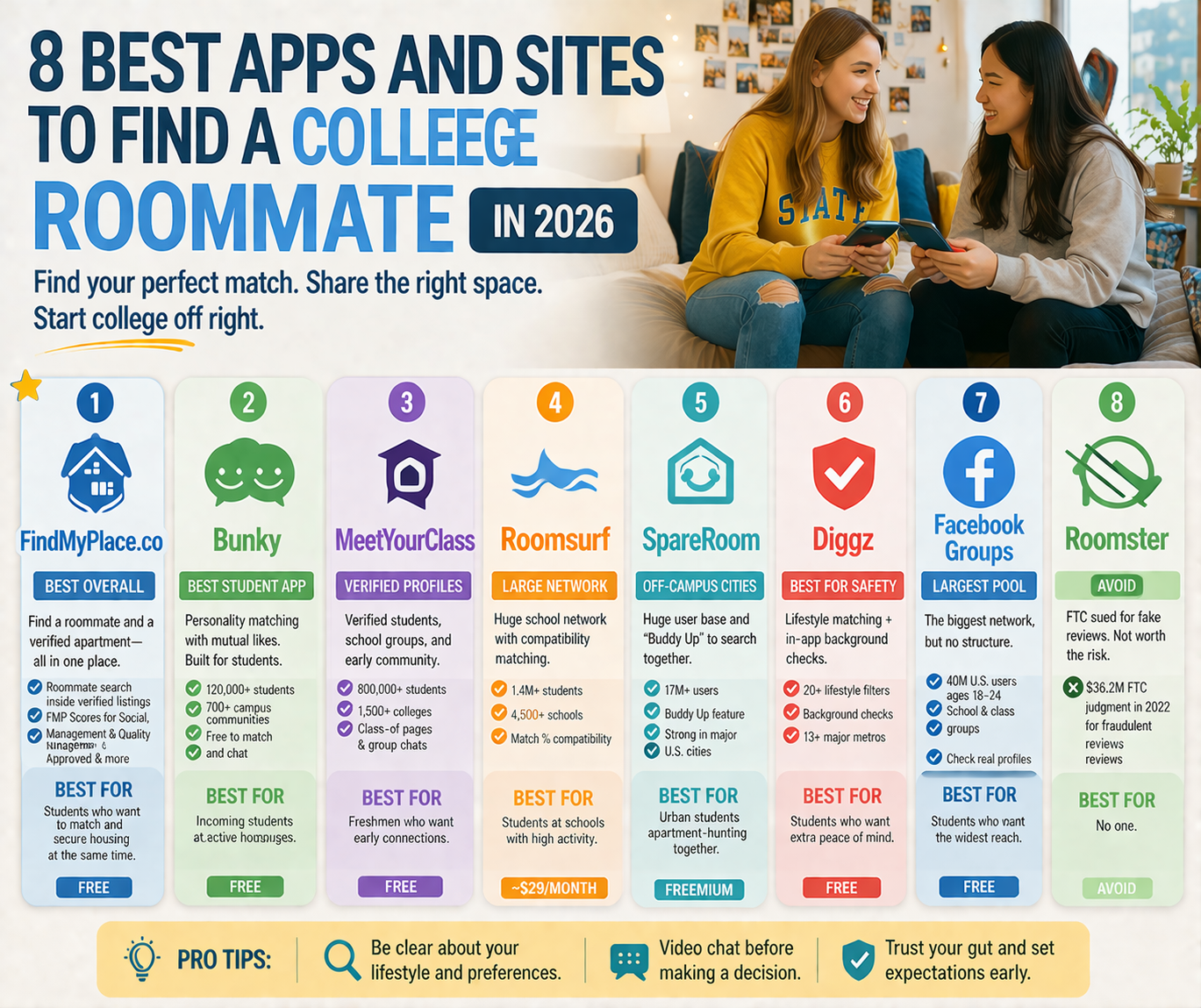
Finding a college roommate in 2026 means choosing from a fragmented market: student-only apps, general platforms adapted for college use, and informal channels like Facebook Groups, each with real trade-offs around cost, verification, and active user bases. The right app depends on your school, your priorities, and how much you’re willing to pay for messaging access.
According to a Benchworks/Elentra dataset of 112,438 students, 87% of first-year college students have at least one roommate. A J Turner Research survey of 7,095 students found that 42% live with three roommates, and only 9% live alone. The roommate search is not a minor logistical step. It directly affects your housing options, your budget, and your first-year experience.
TL;DR: Quick Answer
- FindMyPlace.co ranks first because it combines roommate search with verified housing listings, so you find a person and a reviewed apartment at the same time.
- Bunky and MeetYourClass are the strongest student-only apps for matching, both free to use.
- Roomsurf and SpareRoom have large user bases but charge to send messages, which limits their practical value.
- Diggz offers in-app background checks, making it the best option for off-campus housing in major metros.
- Facebook Groups give you the largest pool of potential roommates at any school, but no structure, no verification, and high spam risk.
- Avoid Roomster: the FTC sued the platform in 2022 for purchasing over 20,000 fake reviews, resulting in a $36.2 million judgment.
Why the Roommate App Market Is Fragmented in 2026
No single platform dominates college roommate search. The market splits into three tiers.
Student-only platforms (Bunky, MeetYourClass, Roomsurf) build school-specific communities with verified student profiles. They know their audience. Their weakness is that user density varies by campus; a platform with 800,000 total users may have 12 active users at your school.
General roommate apps with student appeal (Roomi, SpareRoom, Diggz) have larger overall user bases and stronger safety features, but they are not built for campus life. Filters for BYU-contracted housing, school-specific approval requirements, or freshman-only floors do not exist on these platforms.
Informal channels (Facebook Groups, Reddit) offer the largest raw user pool but no structure, no verification, and wildly inconsistent moderation.
The practical advice: use one student-specific app and one general platform simultaneously, then cross-reference any serious match against their social media presence.
The 8 Best Apps to Find a College Roommate in 2026
1. FindMyPlace.co — Best for Tying Roommate Search to Verified Housing
FindMyPlace solves a problem that roommate-only apps ignore: finding a compatible person means nothing if they have no housing lined up. FindMyPlace integrates roommate discovery directly into verified campus housing listings.
Students search apartments filtered by gender (Male, Female, Coed), room type (Shared or Private), and lifestyle tags including Pet Friendly and LGBTQ+ Friendly. ISO (In-Search-Of) requests and in-platform messaging let students connect within the context of a specific listing. FindMyPlace Score reviews covering Social, Management, and Quality give you insight into the living environment, not just the person you’d be living with.
Campus-specific filters for BYU-contracted, BYU-I Approved, and community housing are not available on any competing platform. Per-person pricing display matches how students actually budget, rather than showing whole-unit rates that obscure what you’d actually pay monthly.
Best for: Students who want to find a roommate and an apartment at the same time, particularly at schools where campus housing approval is part of the process. Cost: Free.
2. Bunky — Best Student-Only Matching App
Bunky is the fastest-growing student roommate app in 2026, with 120,000+ college students across 700+ campus communities. It uses a personality-driven profile system with a mutual-like matching mechanic: both users must like each other before a chat opens, which cuts down on one-sided or unwanted contact.
Students discover Bunky primarily through TikTok and Instagram, which partly explains its rapid growth among current college-age users. Many report it as a replacement for ZeeMee, which has seen declining engagement and persistent app issues.
The free tier covers core matching. Premium perks (seeing who liked you, unlimited likes, visibility boosts) are available for a fee, but students report the free tier is functional for actual roommate finding.
Best for: Incoming students at large universities with active Bunky communities. Cost: Free basic tier; paid premium available. Watch for: App loading bugs noted in recent reviews. Check that your specific campus has meaningful activity before spending time on a profile.
3. MeetYourClass — Best for Verified Student Profiles
MeetYourClass started as the infrastructure behind “Class of [Year]” Instagram pages and has grown to 800,000+ verified students across 1,500+ colleges. Every account requires manual verification before full platform access, and the platform uses automated spam and bot detection on top of that.
Features include school-specific group chats, a college feed for housing and campus Q&A, and automated posting to Class-of Instagram pages. Roommate matching uses filters for interests, study habits, and living preferences. The platform also includes a GPA calculator and class organizer, which keeps students engaged beyond just housing search.
MeetYourClass is particularly strong for incoming freshmen who want to connect with their class before arriving on campus.
Best for: First-year students who want early community access alongside roommate matching. Cost: Free.
4. Roomsurf — Largest School Network, Paywall Problem
Roomsurf claims 1.4 million+ university students across 4,500+ schools, the largest school network of any platform on this list. Its compatibility quiz generates percentage-match scores between users, which gives students a clear signal of fit before any conversation.
The significant problem: Roomsurf charges approximately $29/month to message matches or view social media profiles. App store reviews consistently show students completing a 10+ minute compatibility questionnaire and then hitting this paywall before they can act on any result. The match quality is praised. The monetization structure undermines it.
Best for: Students whose school has high Roomsurf activity and who are willing to pay for messaging access. Cost: ~$29/month for messaging.
5. SpareRoom — Best for Off-Campus Cities, Not Campus Life
SpareRoom is the largest general-purpose platform on this list, with 17+ million registered users worldwide and a 4.6 iOS rating. It originated in the UK but has meaningful activity across major U.S. cities.
The “Buddy Up” feature lets two people without housing search for a place together, which is genuinely useful for students moving to a new city who want to apartment-hunt as a pair. SpeedRoommating events in select cities offer an in-person version of the same idea.
For most college students, SpareRoom is not the right primary app. It is not student-specific, campus filters do not exist, and U.S. users need a paid tier to initiate new conversations. SpareRoom becomes more relevant when you’re moving to a large city after graduation or attending a school embedded in a major metro where the general rental market matters.
Best for: Urban students in markets where SpareRoom has strong activity (NYC, Chicago, LA, DC). Cost: Free to reply to messages already started; paid tier required to initiate new conversations.
6. Diggz — Best for Background Check Capability
Diggz matches users across 20+ lifestyle criteria including tobacco use, cleanliness, eating habits, and preferred interaction level. Its distinctive feature is in-app tenant screening: users can request credit and background checks on potential roommates directly within the platform without going through a third-party service.
Diggz uses AI-powered fraud detection combined with human review of suspicious profiles, and offers multiple verification options including ID, phone, social network, and references. Core features are free.
Coverage is limited to 13+ major U.S. metros: New York, Los Angeles, San Francisco, Chicago, Miami, DC, Houston, Austin, Dallas, Boston, Philadelphia, Atlanta, and Toronto. Students at schools outside those markets will find very little activity.
Best for: Students in major metros who want the option to run a background check before committing to a living situation. Cost: Free core features; background check reports carry a separate fee.
7. Facebook Groups — Largest Pool, No Structure
Facebook Groups remain one of the most widely used roommate-finding channels in 2026, despite having no roommate-specific features. University housing groups, Class-of-year pages, and city-specific roommate groups collectively reach a pool that no dedicated app can match, given Facebook’s 40 million U.S. users aged 18 to 24.
Non-anonymous profiles are the main safety advantage: you can check mutual friends, browse post history, and get a general sense of whether a person is who they claim to be before meeting.
The disadvantages are real. No structured matching, no background checks, inconsistent moderation, high spam volume, and privacy concerns around sharing personal details in a semi-public group. Most students who start here find a candidate and then move the conversation to a direct message or a separate verification step.
Best for: Students whose school has a large, active housing Facebook Group and who want the widest possible initial pool. Cost: Free.
- Roomi — Declining Activity, Strong Safety Features on Paper
Roomi was a category leader as recently as 2022, backed by a Forbes 30 Under 30 founder and an $11 million Series A. By 2026, active listings are limited in most markets, and recent app reviews cite a buggy interface, broken search filters, and low user engagement.
The safety infrastructure is still strong on paper: government-issued ID verification, selfie verification, criminal background checks, and 24/7 content moderation. The cost structure is not student-friendly: full messaging access runs approximately $14.99/week or $23.99 to $29.99/month.
Roomi is not recommended as a primary platform in 2026. It may be worth checking if you are in a major metro and none of the other options have sufficient activity.
Best for: A fallback option in large cities where other platforms are thin. Cost: ~$14.99/week or $23.99-$29.99/month for full access.
One Platform to Avoid: Roomster
Roomster has 10 million+ downloads across 192 countries and appears in many roommate app roundups. Do not use it.
In 2022, the FTC sued Roomster for purchasing more than 20,000 fake reviews to inflate its app store ratings. The settlement resulted in a $36.2 million judgment. Fake reviews distort the information students use to evaluate whether a platform is active and trustworthy. That is a foundational breach of the trust a roommate-matching platform requires.
How to Choose the Right App for Your Situation
Students moving into campus housing with a specific approval requirement (BYU-I Approved, BYU-contracted, etc.) should start with FindMyPlace. The listing-integrated approach removes the common problem of matching with someone who has no approved housing lined up.
Students at large state schools where social networks are well-established should combine MeetYourClass or Bunky for verified matching with their school’s Facebook Group for maximum pool size.
Students moving to a major metro for internships or post-graduation should consider Diggz for its background check capability and SpareRoom’s Buddy Up feature for co-searching.
Whatever platform you start with, verify that your specific school has meaningful user activity before building out a detailed profile. A platform with 800,000 total users and 11 active users at your campus is a worse tool than a well-moderated Facebook Group.
Bottom Line
The best app to find a college roommate depends on your school and what you’re optimizing for. FindMyPlace.co is the strongest option for students navigating campus housing approval processes, because it ties roommate search to verified, reviewed listings rather than treating them as separate problems. Bunky and MeetYourClass are the strongest student-only matching apps for schools where those communities are active. For students in major metros who want additional safety verification, Diggz offers in-app background checks at no cost for core features.
Start your search on FindMyPlace.co to browse campus-specific listings filtered by room type, lifestyle preferences, and per-person pricing.
