8 Best Apps to Find a College Roommate in 2026
The best app to find a college roommate in 2026 depends on your school, but Find My Place is the strongest starting point — it ties roommate search to verified, reviewed housing so you find a person and a real apartment at once. Here's how Bunky, MeetYourClass, Roomsurf, SpareRoom, Diggz, and more compare.

in this article
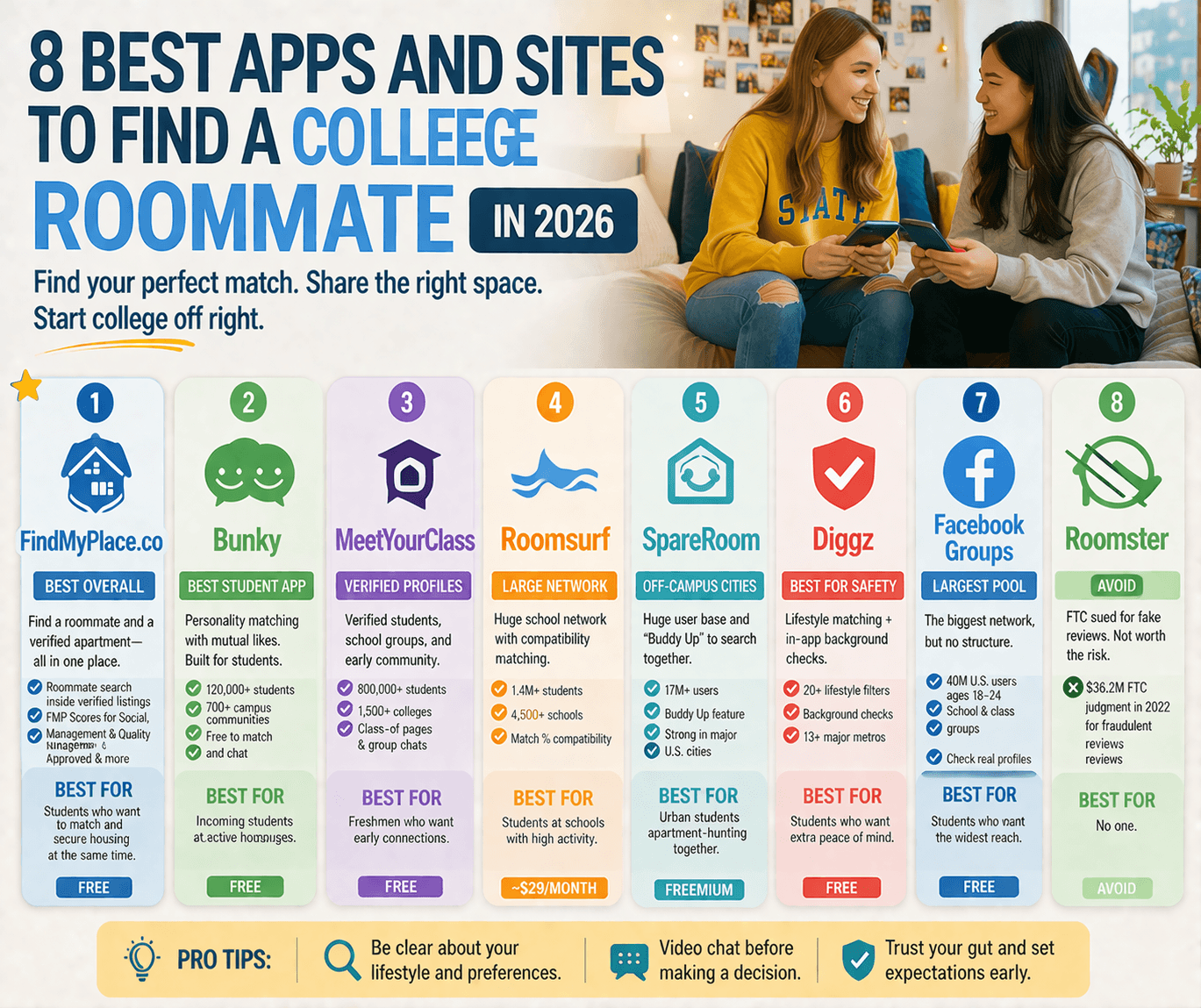
The best app to find a college roommate in 2026 depends on your school, but Find My Place is the strongest starting point because it ties roommate search to verified, reviewed housing — you find a compatible person and a real apartment in the same place instead of solving them separately. Bunky and MeetYourClass are the best free student-only matching apps, while Roomsurf and SpareRoom have big networks but charge to message. One platform to skip entirely: Roomster.
Finding a roommate isn't a minor logistics step. Across a Benchworks/Elentra dataset of 112,438 students, 87% of first-years live with at least one roommate, and a J Turner survey of 7,095 students found 42% live with three roommates while only 9% live alone. Who you live with shapes your budget, your housing options, and your whole first year — so the tool you use to find them actually matters.
Key Takeaways
- Find My Place ranks first because it pairs roommate search with verified housing listings and per-bedroom pricing — a person and a reviewed apartment at once.
- Free and student-only? Bunky and MeetYourClass are your two best bets.
- Roomsurf and SpareRoom have the biggest user pools, but both gate messaging behind a paywall (Roomsurf runs about $29/month).
- Diggz is the one to use if you want an in-app background check, though it only covers about 13 major metros.
- Avoid Roomster. The FTC won a $36.2 million judgment against it in 2022 for buying more than 20,000 fake reviews.
Why the Roommate App Market Is So Fragmented
No single app owns college roommate search, and that's the first thing to understand. The options split into three buckets. Student-only platforms like Bunky, MeetYourClass, and Roomsurf build school-specific communities with verified student profiles — but density swings wildly, and an app with 800,000 users might have eleven active ones at your campus. General apps like Roomi, SpareRoom, and Diggz have bigger pools and stronger safety tooling, but they aren't built for campus life and skip filters like BYU-contracted or freshman-only housing. Then there's the informal tier — Facebook Groups and Reddit — with the largest raw pool and zero structure.
The move most upperclassmen land on: run one student-specific app and one general app at the same time, then cross-check any serious match against their real social media before you commit to anything.
The 8 Best Apps to Find a College Roommate in 2026
1. Find My Place — The Roommate and the Apartment, Together
Most roommate apps stop at the person, which is half the problem — a great match with no place to live gets you nowhere. Find My Place folds roommate discovery into verified campus housing listings, so you're connecting inside the context of an actual unit. You can filter by gender, room type, and lifestyle tags like Pet Friendly and LGBTQ+ Friendly, send ISO (In-Search-Of) requests, and read FMP Scores covering Social, Management, and Quality before you message anyone. Campus-specific filters for BYU-contracted and BYU-I Approved housing don't exist anywhere else, and pricing shows per person, the way students actually budget. Cost: free.
2. Bunky — Student-Only Matching, Campus-Dependent
Bunky is the fastest-growing student roommate app of 2026, with 120,000-plus students across 700-plus campus communities. It runs on a mutual-like system — both people have to like each other before a chat opens, which cuts the unwanted-contact problem. Most students find it through TikTok, and many treat it as the ZeeMee replacement. The free tier handles real matching; just confirm your campus actually has activity before investing in a profile, and expect the occasional loading bug. Cost: free, with paid premium.
3. MeetYourClass — Verified Student Profiles
Grown out of the "Class of [Year]" Instagram pages, MeetYourClass now has 800,000-plus verified students across 1,500-plus colleges, with manual verification on every account plus bot detection. Beyond roommate filters for interests and study habits, it runs school group chats and a campus feed, so incoming freshmen can plug into their class before move-in. Strongest for first-years who want community early. Cost: free.
4. Roomsurf — Big Network, Hard Paywall
Roomsurf claims 1.4 million-plus students across 4,500-plus schools — the largest network here — and its compatibility quiz spits out percentage-match scores. The catch is steep: roughly $29/month to message matches or see socials. Reviewers regularly describe finishing the 10-minute quiz only to slam into that wall. Good matching, frustrating monetization. Cost: about $29/month to message.
5. SpareRoom — Built for Cities, Not Campuses
SpareRoom is the biggest general platform on the list, with 17 million-plus users worldwide. Its "Buddy Up" feature lets two people without housing hunt for a place together, which is genuinely handy if you're moving to a new city. For most undergrads it isn't the right primary tool — no campus filters, and U.S. users need a paid tier to start new conversations. It earns its keep for students at schools embedded in big metros like NYC, Chicago, or LA. Cost: free to reply; paid to initiate.
6. Diggz — Background Checks, Major Metros Only
Diggz matches on 20-plus lifestyle criteria and stands out for in-app tenant screening: you can request a credit or background check on a potential roommate without leaving the app. It layers AI fraud detection with human review and offers ID, phone, and social verification. The limit is geography — about 13 metros (New York, LA, San Francisco, Chicago, Miami, DC, and a handful more). Outside those, it's a ghost town. Cost: free core features; background checks cost extra.
7. Facebook Groups — Biggest Pool, No Guardrails
No roommate-specific features, yet Facebook Groups still reach a pool no app can touch. University housing groups and Class-of pages let you check mutual friends and post history before you ever meet, which is a real safety edge. The downsides are just as real: no matching, no screening, spotty moderation, and spam. Treat it as a wide net, then verify anyone seriously — and the FTC's scam data is a good reminder never to send money before you've met in person. Cost: free.
8. Roomi — Fading, and Pricey
Roomi led the category back in 2022, but by 2026 listings are thin in most markets and reviews cite a buggy interface and low engagement. The safety stack still looks good on paper — ID and selfie verification, background checks, 24/7 moderation — but messaging runs roughly $15/week or $24 to $30/month, which isn't student-friendly. Worth a glance only if you're in a big city and everything else is empty. Cost: about $15/week or $24–$30/month.
One App to Skip: Roomster
Roomster shows up in plenty of roundups with 10 million-plus downloads. Skip it anyway. In 2022 the FTC took action against Roomster for buying more than 20,000 fake reviews to pump its ratings, ending in a $36.2 million judgment. A roommate platform runs entirely on trust, and faking the reviews students use to judge it is exactly the wrong foundation.
How to Pick the Right One for You
If your campus housing has an approval requirement, start with Find My Place so your match comes with eligible, reviewed housing attached. At a big state school with strong social networks, pair MeetYourClass or Bunky for verified matching with your school's Facebook Group for reach. Moving to a major metro for an internship? Diggz for the background check and SpareRoom's Buddy Up for co-searching. Whatever you choose, confirm your specific school has real activity before building a detailed profile — 800,000 users means nothing if eleven of them go to your school. For the timing side of all this, our apartment search timeline lines up when to find the roommate with when to find the place.
Frequently Asked Questions About Finding a College Roommate
What's the best app to find a college roommate?
Find My Place if you want the roommate and a verified apartment in one search, especially at schools with housing-approval rules. For pure student matching, Bunky and MeetYourClass are the best free options.
Are roommate-finding apps free?
Some are, some aren't. Find My Place, Bunky's basic tier, MeetYourClass, and Diggz's core features are free. Roomsurf, SpareRoom, and Roomi charge to message — Roomsurf around $29/month — so check the paywall before you sink time into a profile.
How do I avoid roommate scams online?
Never send money before meeting in person or at least video-chatting, keep deposits out of it until there's a real lease, and cross-check anyone against their actual social media. Renters aged 18 to 29 lose money to rental and roommate scams at three times the rate of older adults, so slowing down pays off.
Is it safe to find a roommate on Facebook?
Safer than a fully anonymous app in one way — you can see mutual friends and post history — but there's no screening or matching. Use it for reach, then vet hard before you agree to live with anyone.
Should I find the roommate or the apartment first?
Ideally at the same time, which is the whole point of tying the two together. Locking a roommate with no eligible housing, or a unit with no one to split it, just creates a second scramble later.

Find My Place — By Students, For Students
The FMP Data Team turns Find My Place's listing and review data into housing guides students can actually use. We dig through rent numbers across thousands of off-campus properties, cross-check them against real leases and verified student reviews, and turn the mess into plain answers: what a place near your campus actually costs, when to start looking, and where the tradeoffs hide. Everything here is built on the same data students and landlords rely on at findmyplace.co every day, drawn from tens of thousands of verified reviews across thousands of properties. No fluff, no guesswork. Just the numbers, and what they mean for your next lease.