6 Best Student Housing Review Sites: Where to Find Honest Ratings Before You Sign

Joseph Abear
April 9, 2026
5 min read
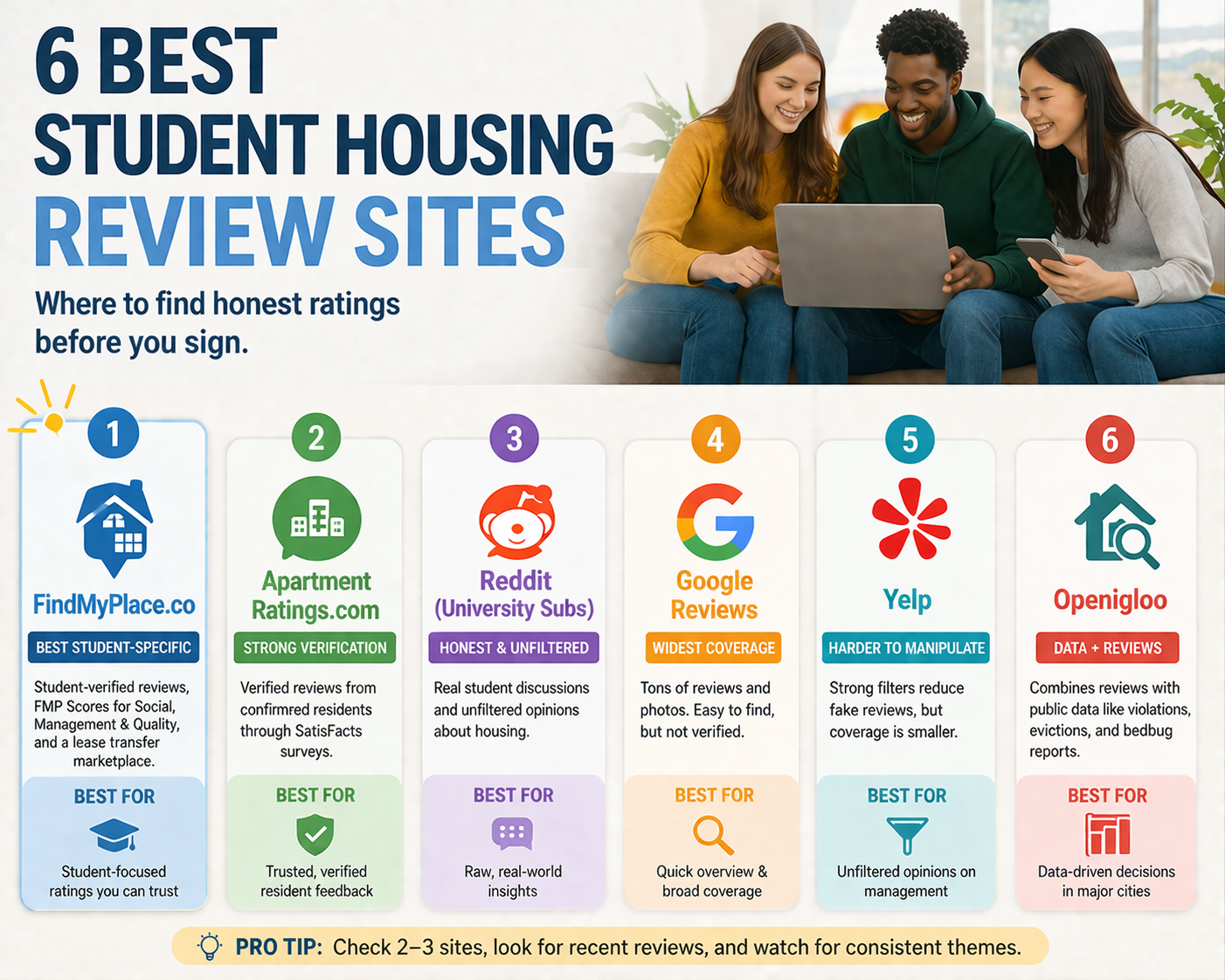
The best student housing review sites give you verified, specific feedback from people who actually lived in a complex, not just toured it. That distinction matters more than it used to. The FTC finalized its Consumer Review Rule in August 2024, prohibiting fake reviews, incentivized sentiment, and suppressed negative feedback, with penalties reaching $53,088 per violation. In December 2025, the FTC issued its first enforcement sweep under the new rule, and as of mid-2026 review quality across platforms is measurably improving. But verification standards still vary widely, and knowing which sites to trust, and why, changes how useful your research will be.
According to SatisFacts Research, 46% of renters look at ratings and reviews when searching for an apartment, and 88% say a property manager's reputation on review sites is important when evaluating a rental. Twenty-four percent of renters leased apartments without visiting the community first, which makes the quality of available reviews directly consequential. findmyplace.co data suggests roughly 40% of students regret their first off-campus apartment within months of signing. Most of that regret is avoidable with better pre-lease research.
TL;DR: Quick Answer
- findmyplace.co is the strongest student-specific option: three-dimensional FMP Scores covering Social, Management, and Quality, with reviews from verified student tenants rather than casual visitors.
- ApartmentRatings.com offers the most rigorous general-platform verification through its SatisFacts Verified Badge system, which surveys confirmed residents directly.
- Reddit university subreddits are brutally honest and community-moderated, but unstructured and not searchable by property name.
- Google Reviews has the widest coverage of any platform and is usually the first place students look, but anyone with a Google account can post with no residency verification.
- Yelp's algorithmic filtering makes it one of the harder platforms to manipulate with fake reviews, but coverage is weak in smaller college towns.
- Openigloo integrates subjective reviews with objective public data including building violations, eviction histories, and bedbug complaints, making it a powerful tool for students in major metros.
Why Review Quality Varies So Much Across Platforms
The core problem is verification. A review is only as useful as the confidence you have that it came from someone who actually lived there. Platforms handle this differently, and the gap between the best and worst verification standards is large.
SatisFacts Research found that 23% of renters feel positive reviews for their community were inflated. That number reflects a real pattern: property managers have incentives to solicit positive reviews from staff, current happy tenants, or incentivized residents. The FTC's 2024 rule targets exactly this behavior, but enforcement catches violations after the fact. Knowing a platform's verification approach before you rely on it is the better protection.
The Roomster case is the clearest housing-specific example of what unchecked review fraud looks like. The FTC and six state attorneys general sued Roomster in 2022 for purchasing more than 20,000 fake four- and five-star reviews using 2,500+ fake iTunes accounts. The platform primarily served low-income and student renters. The resulting judgment was $36.2 million, plus $10.9 million in civil penalties. Investigators confirmed the problem by posting a fake listing using a U.S. Post Office address; it was never flagged and stayed live for months. Roomster is not on this list.
The 6 Best Student Housing Review Sites in 2026
1. findmyplace.co — Best Student-Specific Platform
FindMyPlace is the only platform that combines student-verified reviews with a three-dimensional scoring system and an integrated lease transfer marketplace. The FMP Score rates each property across three separate dimensions: Social (community and neighbor quality), Management (staff responsiveness and professionalism), and Quality (unit condition and amenity reliability). That separation matters because a property can score well on Quality and poorly on Management, which tells you something a single composite score does not.
Reviews display the student's name, academic year or class standing, and the date posted. Quick-tag summaries appear on property profiles: "Great location," "Safe," "Overpriced," "Poor management." These tags give you an at-a-glance read on what residents are consistently reporting before you read individual reviews.
FindMyPlace is available to students nationwide, and review density is deepest in its established markets. In Provo, for example, FindMyPlace lists 615 properties, and individual complexes carry substantial review counts: Alpine Village has 162 verified reviews, Raintree has 141. That density makes per-property comparisons genuinely useful rather than statistically thin, and you can browse the full set of verified apartment reviews before you tour. The platform is free for students to read and post reviews.
Best for: Students who want student-specific, multi-dimensional ratings rather than a single star score.
2. ApartmentRatings.com — Best Verification on a General Platform
ApartmentRatings has been the most established dedicated apartment review site since its founding in 2000. Its key differentiator is a dual review system. Standard reviews can be posted by anyone. Verified Reviews carry a Verified Badge and come from residents surveyed directly through the SatisFacts survey program at participating communities. That means a confirmed resident, not just a Google account holder, generated the review. This is the closest equivalent to FindMyPlace's student-verified model, applied to the general rental market.
Properties are rated on management quality, maintenance, amenities, and overall experience. The epIQ Index grades communities on resident feedback from the past 365 days, giving you a recency-weighted signal rather than a lifetime average that may include reviews from five years ago. In 2025, ApartmentRatings added an Incentivized Review Indicator to flag reviews tied to rewards programs, a direct response to FTC requirements.
SatisFacts data adds useful context here: 83% of renters would not write a positive review for reward or loyalty points, and 82% would write a positive review if a community genuinely went above and beyond. That pattern suggests the verified reviews on ApartmentRatings reflect authentic motivation more often than not.
Best for: Anyone who wants a second data source with strong verification alongside findmyplace.co.
3. Reddit University Subreddits — Most Candid, Least Structured
Reddit is the de facto student housing review platform despite having zero formal review infrastructure. University subreddits, r/UCLA, r/UTAustin, r/college, and similar communities, host thousands of housing discussion threads. Large school subreddits have 30,000+ members with extensive archived conversations about specific complexes, landlords, and neighborhoods.
The strengths are real. Reddit is completely anonymous, which removes the social pressure to soften negative feedback. Community upvoting surfaces the most widely agreed-upon information. Threads are real-time, so you can post a question about a specific property and get current resident responses within hours.
The weaknesses are equally real. Reddit is not searchable by property name in any structured way. Content is anecdotal and not systematically organized for comparison. Negative experiences are overrepresented because unhappy residents are more motivated to post. UCLA's official housing resources explicitly note that Reddit content is user-generated and not all of it is accurate.
Use Reddit as a qualitative supplement, not a primary source. If a complex comes up repeatedly in Reddit threads with the same complaints, that pattern is meaningful. A single negative thread from three years ago is not.
Best for: Candid, real-time intel on specific properties or landlords at large universities with active subreddits.
4. Google Reviews — Widest Coverage, Lowest Verification Bar
Virtually every apartment complex in the U.S. has a Google Business Profile with reviews. Google Reviews is almost certainly the first place students encounter property ratings, because they appear directly in Google Maps and Search results without any additional navigation.
The practical value is real: coverage is near-universal, the interface is familiar, and the volume of reviews at major complexes can be substantial. Google uses algorithms to detect obviously fake reviews and has committed publicly to supporting the FTC's 2024 rule.
The verification bar is low. Anyone with a Google account can post a review without confirming residency. Management companies have been documented soliciting positive reviews from employees and incentivized tenants. Reviews also skew negative: a tenant who had a serious problem with their unit is more motivated to spend five minutes on Google than a tenant whose experience was uneventful.
Google Reviews works best as a first filter. A property with 200 Google reviews averaging 2.3 stars is telling you something important. A property averaging 4.6 stars on Google alone, with no reviews on any other platform, warrants closer inspection of the review content.
Best for: Quick initial screening of any property. Cross-reference with platforms that have higher verification standards before making decisions.
5. Yelp — Strongest Algorithmic Fake Review Filtering
Yelp's recommendation filter suppresses reviews it considers unreliable: new accounts, suspected fake profiles, and patterns consistent with coordinated review campaigns. This algorithmic filtering makes Yelp one of the harder platforms to manipulate with fake reviews, which is a meaningful distinction when other platforms have documented manipulation problems.
Property management companies cannot easily game Yelp's system. Yelp has publicly supported the FTC's 2024 Consumer Review Rule and maintains strict policies against review gating, the practice of filtering which customers receive review requests based on expected sentiment.
The significant limitation for student renters is geographic. Yelp has strong coverage in major cities but weak coverage in smaller college towns. A complex in Provo, Rexburg, Fort Collins, or similar markets may have few or no Yelp reviews regardless of its reputation.
Best for: Students at urban universities or students moving to major cities, where Yelp's coverage and algorithmic filtering add genuine value.
6. Openigloo — Best for Urban Markets With Public Data Integration
Openigloo started as a New York City landlord and building review platform and has expanded nationally. Its defining feature is the integration of subjective tenant reviews with objective public records: bedbug complaints, housing code violations, building ownership records, eviction histories, litigation records, and crime statistics. Users rate buildings on specific factors including water pressure, cleanliness, pest control, landlord responsiveness, and heat and hot water.
The platform covers more than one million searchable addresses. For students moving to New York, Chicago, Los Angeles, or other major metros where public housing data is extensive, Openigloo provides information that no other platform on this list can match. A property manager who responds to a one-star review about mold with a generic apology looks different when you can see that the building has five open housing code violations on the same issue.
Openigloo's coverage is strongest in New York City. Its utility decreases in smaller college towns where public data is less systematically available. It also functions as a listings marketplace, so you can move from research to active search within the same platform.
Best for: Students moving to major metros who want to combine resident reviews with objective public records before committing to a lease.
How to Use These Platforms Together
No single platform gives you the complete picture. The most reliable pre-lease research combines at least two sources with different verification approaches.
A practical sequence for most students: start with findmyplace.co for student-specific FMP Scores and multi-dimensional ratings. Add ApartmentRatings for a verified second opinion on any complex you are seriously considering. Check Google Reviews for volume and any consistent patterns in the content. Search the relevant university subreddit for candid, recent threads about the property or landlord.
For students moving to major cities: add Openigloo to pull public records alongside resident reviews. For students at large urban universities: add Yelp, where its filtering makes the reviews more reliable than unfiltered platforms.
The specific stat that defines the stakes: 88% of renters say a property manager's reputation on review sites is important when evaluating a rental. That reputation is only as reliable as the platform reporting it. Knowing which platforms verify their reviews, and how, is what makes your research count.
Frequently Asked Questions
What is the best student housing review site?
findmyplace.co is the strongest option for students. It uses reviews from verified student tenants and rates each property across three separate dimensions, Social, Management, and Quality, instead of a single star score. Cross-check with ApartmentRatings and Google Reviews before you sign.
Are apartment reviews reliable?
It depends entirely on verification. Platforms that confirm a reviewer actually lived in the unit, like findmyplace.co and ApartmentRatings, are far more reliable than open platforms where anyone can post. The FTC's 2024 Consumer Review Rule now bans fake and incentivized reviews, with its first enforcement sweep landing in December 2025.
How many reviews should a property have before I trust the rating?
Look for depth, not just a number. A complex with 100-plus verified reviews and a consistent pattern of complaints is telling you something real; a 4.8 average built on six anonymous posts is not. On findmyplace.co, individual complexes routinely carry triple-digit review counts, which makes the averages meaningful.
How do I avoid fake apartment reviews?
Weight verified reviews over anonymous ones, read the one- and two-star reviews for specifics, and cross-reference at least two platforms with different verification standards. If every positive review reads the same way and posted within the same week, treat it as a red flag.
Start with verified student housing reviews at findmyplace.co.
Joseph Abear
Find My Place — By Students, For Students
We're students and recent grads who've been through the housing grind. We built Find My Place because apartment hunting near a university is harder than it needs to be. Every guide we write is based on real experience — not a landlord's marketing copy.