Off-Campus Student Housing Costs in 2026: $300 to $2,500 per Person
Off-campus student housing in 2026 runs $300–$2,500 per person per month — most students land around $800 for a private bedroom. Full breakdown by roommate count, city type, and unit type, plus the $100–$300 in hidden fees to add to every listing.

in this article
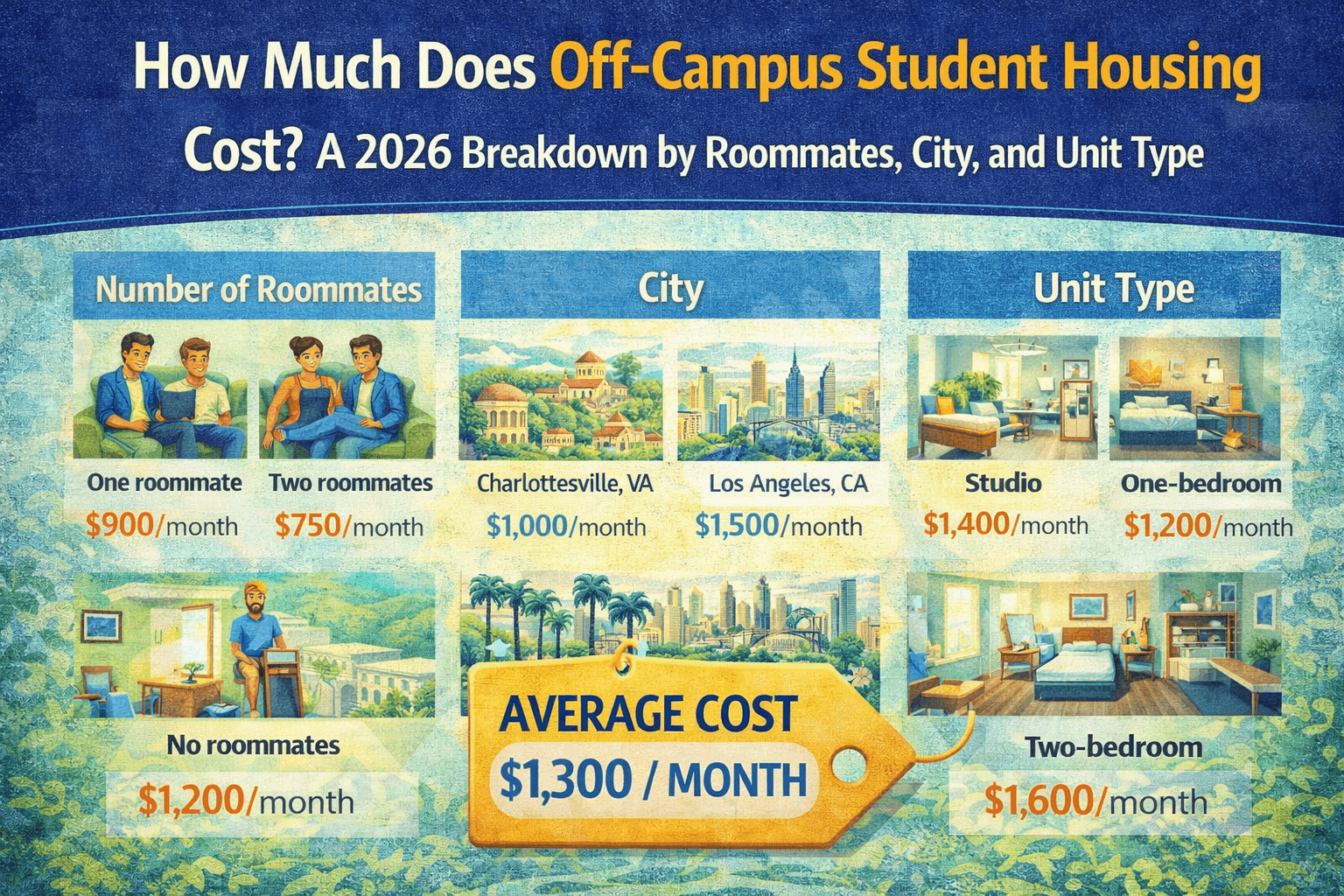
Here's the short version: off-campus student housing in 2026 runs anywhere from $300 to $2,500+ per person per month. Most students land around $800 for a private bedroom in a shared apartment. A shared room in a college town? As low as $300. A solo studio in Boston or SF? Easily $2,500 and up. Three things explain nearly all the variance — how many roommates you have, what kind of city your school is in, and what unit you rent.
Key Takeaways
- College-town rent per person: $300–$500. Mid-size university city: $600–$1,100. Sun Belt metro: $900–$1,600. Coastal city: $1,500–$2,500+.
- Roommates do more work for your budget than any other lever. A 4-bedroom split three ways saves roughly $700–$1,000 a month compared to going solo.
- Shared bedrooms: $300–$700 per person. Private room in a shared apartment: $450–$1,100. Solo studio: $900 to $2,500+ depending on the market.
- Whatever rent you see on the listing, add $100–$300 for utilities, parking, and fees. That's your real number.
- Nationally, the average off-campus student at a 4-year public college spends about $10,781 per year on housing — roughly $1,080 a month across a 10-month school year.
- Find My Place posts verified, student-reviewed pricing on every listing, so you're comparing real numbers instead of leasing-office fiction.
The 2026 National Baseline
Students at 4-year public schools who live off-campus pay around $10,781 a year for housing on average. That's per Education Data Initiative's 2026 read of NCES figures — and like most national averages, it obscures more than it reveals. Spread across a 10-month academic year, it works out to about $1,080 a month. But whether you're paying $400 or $1,800 depends almost entirely on where your school is.
So let's be specific. Here's what students are actually handing over each month in 2026, broken down by city type:
Market TypePer-Person Monthly Cost Small college towns (Rexburg ID, Provo UT, Logan UT)$450–$800 Mid-size university cities (Tempe AZ, Boise ID, Fort Collins CO)$600–$1,100 Large Sun Belt metros (Denver CO, Las Vegas NV, San Diego CA)$900–$1,600 High-cost coastal cities (NYC, Boston, LA, Seattle)$1,500–$2,500+For context: rent around major universities jumped 33% between 2020 and 2025, while financial aid barely kept pace. Sun Belt markets have cooled a bit from their 2024 peak thanks to new supply coming online, but don't mistake that for cheap. Almost every market still sits well above where it was pre-pandemic.
Cost by Roommate Count
If you want to save money, add roommates. It is that simple.
A 4-bedroom apartment at $1,600 a month costs you exactly $1,600 if you sign alone. Split it three ways and you're at $400 each. Over a 10-month lease, that choice is worth $12,000 — the difference between "housing is crushing me" and "I can actually afford groceries, a car payment, and a trip home at Christmas."
Living SituationTotal Rent (Typical)Per-Person Cost Solo studio or 1-bedroom$1,100–$1,600/mo$1,100–$1,600 2-bedroom, 1 roommate$1,100–$1,600/mo$550–$800 3-bedroom, 2 roommates$1,200–$1,800/mo$400–$600 4-bedroom, 3 roommates$1,400–$2,200/mo$350–$550 Shared bedroom (2 per room)$600–$1,000/mo$300–$500My honest take: if you're past freshman year, pick the highest roommate count you can stomach. Studios sound romantic and feel great for about a month. Then you realize you're paying $700 more every single month for the privilege of not having anyone to order pizza with. Privacy is a luxury. Price it like one.
Cost by City Type
Your school's zip code does more to your budget than most students realize. A private room in Provo runs about the same price as a shared bedroom in San Diego. Same money, very different experience.
MarketShared RoomPrivate RoomSolo Studio Small college town$300–$500$450–$700$800–$1,100 Mid-size university city$500–$800$650–$1,000$1,100–$1,500 Large Sun Belt metro$700–$1,100$900–$1,400$1,500–$2,100 High-cost coastal city$1,000–$1,600$1,400–$2,200$2,500+Obviously, you're not about to transfer. But here's a strategy worth considering if you're at a high-cost school with a tight budget: the suburbs. A 30-minute commute from a cheaper adjacent town can knock $500–$800 off your monthly housing bill. Transit, gas, and time are real costs, but usually not $500-worth of real.
Cost by Unit Type
Four configurations cover basically the entire off-campus market. Pick yours:
Shared bedrooms. Two students, one room, usually inside a purpose-built student complex. $300–$700 per person. Mostly a Utah and Arizona thing. It is cheap — which is the whole point. The trade-off is sleep privacy, which matters more to some people than others. If you're the kind of student who lives on campus anyway and treats your bedroom as a place to crash, you won't notice much. If you're a night owl with a roommate who wakes up at 6 AM, you'll notice every single day.
Private bedrooms in shared apartments. Your own bedroom, shared kitchen and bathrooms. $450–$1,100 per person. This is the default setup for most off-campus students nationwide, and for good reason. Per Find My Place's 2026 listings in Utah and Arizona, private rooms in 4-bedroom apartments sit in the $550–$750 range most of the time.
Studios and 1-bedrooms. Full independence. Your own kitchen, your own bathroom, your own problems. $900–$2,100 depending on the market. Financially, this makes sense if you're a grad student, have steady income, or have family help. On a standard undergrad aid package? Almost never the right call.
By-the-bed leases. You sign for your bedroom only, not the whole unit. Price is similar to a private room ($500–$1,000), but if a roommate stops paying rent, the property chases them — not you. That insulation is worth hunting for, especially if you're signing with people you don't know well. Professionally managed student complexes are where these live.
What Advertised Rent Doesn't Include
The number on the listing is not the number you'll pay. Every semester, students get burned by this.
CostMonthly RangeNotes Electricity$20–$80 per personBig in AC-heavy summers and cold-heat winters Internet$15–$40 per personUsually around $75 total for the unit Water, sewer, trash$15–$35 per personOften included in purpose-built student housing Parking$30–$150 per personNear-campus spots are expensive. Free if you bike/bus. Renter's insurance$10–$20 per monthTypically required by the landlord Move-in fees$150–$500 one-timeApplication, admin fee, security depositDo the math and the real monthly cost is $100–$300 above sticker. A $700 listing becomes an $850–$1,000 reality by the time the first electric bill hits. One move: before you sign, ask the property manager for an average utility estimate — in writing. Not a guess from the leasing tour, an actual number.
Financial Aid and Off-Campus Housing
Good news: most federal aid works for off-campus housing. Pell Grants, subsidized loans, unsubsidized loans, nearly every scholarship — all of it. The FAFSA Cost of Attendance has a housing allowance baked in for off-campus students, and your aid gets sent to your school first, then released to you as a refund a few weeks into each semester.
Here's the catch nobody warns you about: there's a gap between when rent is due (day one of the month) and when your aid refund lands (two to four weeks into the semester). Plan for a one-month cash buffer before move-in. Getting caught between a rent deadline and a pending aid disbursement is the single most common financial panic students experience their first year off campus. Build the buffer. Future you will be grateful.
Frequently Asked Questions About Off-Campus Student Housing Costs
How much should I budget per month?
At a mid-size university with a private room in a 3 or 4-bedroom apartment: plan on $600–$900 all-in. Shave $200–$300 for a small college town. Add $400–$1,000 for a big metro or coastal city. Those ranges already include a utility and fee cushion, which most "budget calculators" skip.
Is off-campus cheaper than the dorms?
Usually. Not always. Dorms with a meal plan typically hit $12,000–$18,000 a year. A shared off-campus bedroom in a college town can clear under $6,000 including utilities — a huge win. But a solo studio in a coastal city will cross $25,000 and make the dorms look downright reasonable. The extremes aren't symmetrical.
What's the cheapest option, full stop?
A shared bedroom in a purpose-built student complex in a small college town. $300–$500 per person, and most utilities are usually bundled in. You'll find these in Utah, Idaho, and parts of Arizona. Not for everyone — you're sharing a sleeping space — but on pure dollars per month, nothing beats it.
When should I start looking?
Six to nine months before move-in is the sweet spot for most markets. If you're at a school with tight inventory (Provo, Logan, Tempe), bump that to nine to twelve. Waiting until summer for a fall lease is the worst move: you're picking from what nobody else wanted, at peak prices.
Can I use financial aid to pay rent?
Yes. Your school applies aid to tuition first, then refunds the remainder to you. That refund becomes your rent, food, and everything else money. The timing lag is the only real catch — see the financial aid section above.
Why is my real monthly cost higher than my rent?
Utilities, parking, internet, renter's insurance, and move-in fees — in that order, roughly. Base rent almost never includes electricity, and rarely includes internet or parking. A good rule: add $100–$300 to whatever's on the listing, and ask for average utility numbers in writing before you sign anything.

Find My Place — By Students, For Students
The FMP Data Team turns Find My Place's listing and review data into housing guides students can actually use. We dig through rent numbers across thousands of off-campus properties, cross-check them against real leases and verified student reviews, and turn the mess into plain answers: what a place near your campus actually costs, when to start looking, and where the tradeoffs hide. Everything here is built on the same data students and landlords rely on at findmyplace.co every day, drawn from tens of thousands of verified reviews across thousands of properties. No fluff, no guesswork. Just the numbers, and what they mean for your next lease.