
Student Housing Rent: What’s Included and What Isn’t
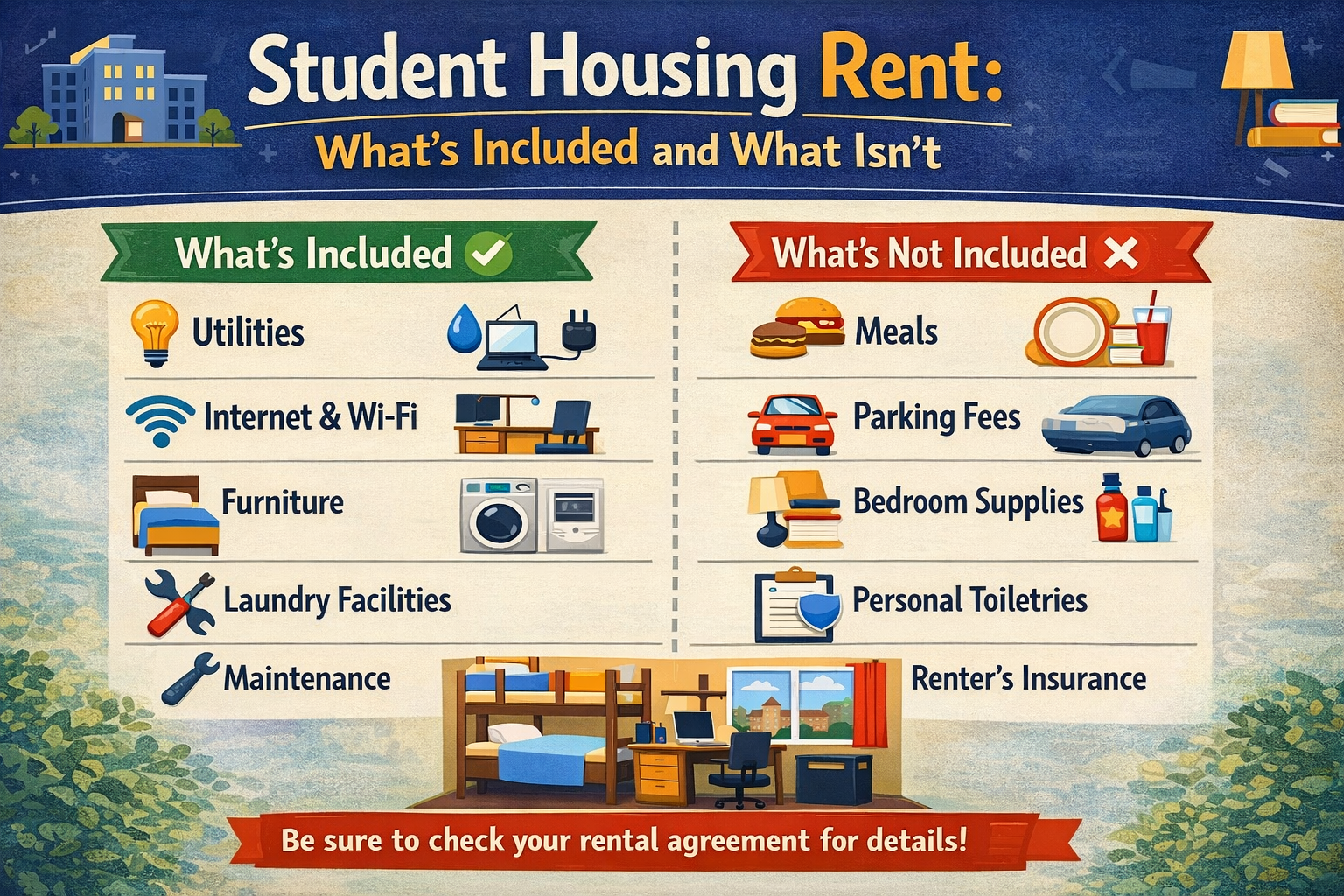
Student housing rent covers your right to occupy the unit, and usually includes water, trash, and basic maintenance. It almost never covers electricity, parking, renter’s insurance, or furniture. The gap between what rent includes and what your actual monthly bill totals runs $100–$300 for most students, and sometimes more.
That gap exists because “rent” and “total housing cost” are two different numbers. Landlords advertise the first one. The second one is what you actually pay each month. Understanding which costs fall inside rent and which fall outside it is the most important step you can take before signing any student housing lease.
TL;DR: What Rent Covers and What It Doesn’t
- Student housing rent almost always covers the unit itself, most routine repairs, and trash collection.
- Water and sewer are included in roughly 70 percent of multi-unit apartment buildings nationally, but not all.
- Electricity is almost never included; expect to set up your own account and pay $30–$60 per person monthly, higher in hot or cold climates.
- Parking, renter’s insurance, and furniture are excluded in the vast majority of off-campus student leases.
- Purpose-built student housing complexes include more (furniture, internet, water) than private rentals, but base rent is usually higher to reflect it.
What Student Housing Rent Almost Always Covers
Your unit. Every lease covers the right to occupy your defined space: your bedroom, your share of common areas, and any storage specified in the unit description. In purpose-built student housing, the lease typically defines the unit as your bedroom only, with kitchen, living room, and bathrooms shared among all tenants. In a private rental, the lease usually covers the whole apartment as a joint tenancy. Confirm exactly which spaces are yours before signing.
Routine maintenance and repairs. Landlords are legally required to maintain habitable conditions in every state: functioning plumbing, working heat, structural safety, freedom from infestations. Repairs resulting from normal wear fall on the landlord. Damages you cause fall on you. If a repair request goes unanswered for more than 14–30 days for non-emergency issues, document every communication in writing. That paper trail matters if you need to invoke habitability protections later.
Trash and recycling. Trash pickup is covered in nearly all student rentals, either folded into rent or handled through a municipal contract paid by the property owner. The exception is some older private houses converted to student rentals, where landlords occasionally charge a separate $10–$25 monthly fee. Rare, but worth confirming for private rentals outside professionally managed complexes.
What Student Housing Rent Sometimes Covers — Ask Before You Sign
Water and sewer. About 70 percent of multi-unit apartment buildings nationally include water and sewer in the rent, according to Apartment List. Buildings with a single master meter typically fold the cost into rent and allocate it by square footage or flat rate. Buildings where each unit has its own meter usually bill tenants separately. Ask directly: is water billed through my rent, or will I receive a separate bill?
Heat and gas. Regional patterns matter here. In northern and Midwestern states where heating costs are significant, many landlords include heat in rent to avoid disputes over winter bills. In Sun Belt markets including Arizona, Nevada, Utah, and Southern California, tenants almost universally pay their own heating costs. If the building uses gas for heat, cooking, or hot water, clarify which uses are your responsibility before signing.
Internet. Purpose-built student housing complexes marketed specifically to college students frequently include internet as a bundled amenity, either built into rent or listed as a free perk. Private landlords almost never include it. If a listing advertises internet as included, ask about the speed tier and whether there is a usage cap. A throttled plan won’t support four students streaming, attending video classes, and working from home simultaneously.
Laundry access. On-site laundry is common in larger complexes but ranges from in-unit hookups at no cost, to shared coin-operated machines at $2–$4 per load, to no facility at all. Budget $20–$50 per month for laundry if the unit doesn’t have in-unit connections.
What Student Housing Rent Almost Never Covers
Electricity. This is the utility most reliably billed separately to tenants. Because electricity consumption varies so much between households, landlords almost universally prefer individual metering. Expect to set up your own account with the local utility. National averages from Apartment List place electricity at $115–$160 per month for a one-bedroom apartment. Split among roommates, that drops to $30–$60 per person. In hot-climate markets like Arizona and Nevada, summer air conditioning pushes this to $80–$120 per person monthly from June through August.
Parking. Near-campus parking is almost never included in base rent, even when a lot exists on the property. Expect $30–$150 per month for a designated space depending on the market. Students in walkable or transit-accessible locations eliminate this cost entirely by going car-free, which is an increasingly practical choice in densely built university markets.
Renter’s insurance. Your landlord’s building insurance covers the structure, not your belongings or your personal liability. Renter’s insurance covers your laptop, your bike, your clothes, and your liability if someone is injured in your unit. It is never included in rent. It typically costs $10–$20 per month for a standard policy. Many landlords now require it as a lease condition. Even when they don’t, one laptop theft or water damage incident without coverage costs more than several years of premiums.
Furniture. Private rentals are almost always unfurnished. Setting up a modest apartment from scratch runs $1,500–$3,000 buying new; secondhand finds can reduce that significantly. Purpose-built student housing typically includes bedroom basics: a bed frame, mattress, desk, and chair. If a listing is furnished, confirm in writing exactly what is and isn’t provided.
Mandatory fees. Some complexes charge amenity fees, technology packages, or admin fees of $50–$150 per month that don’t appear in the advertised rent price. These are legally required to be disclosed before you sign, but they may not appear in the headline listing. Ask specifically whether there are any recurring charges beyond monthly rent.
Purpose-Built Student Housing vs. Private Rentals
These two categories handle rent inclusions differently. Knowing which type you’re renting before you tour saves a lot of surprises.
| Purpose-Built Student Housing | Private Rental | |
| Furniture | Usually included | Almost never included |
| Internet | Often included or bundled | Rarely included |
| Water and sewer | Usually included | Varies by landlord |
| Electricity | Almost never included | Almost never included |
| Parking | Available as add-on, $30–$100/mo | Varies |
| Lease type | Often by-the-bed | Almost always joint lease |
By-the-bed leases are common in purpose-built student housing and worth understanding. Each tenant signs an individual lease for their specific bedroom rather than a joint lease for the whole unit. The practical difference: if a roommate stops paying rent, it doesn’t affect your lease, your credit, or your liability. Joint leases, standard in private rentals, make all tenants mutually responsible for the full rent.
Find My Place listings include student-verified reviews that flag hidden costs, unexpected fees, and actual utility patterns at specific properties. Reading a few reviews before touring a complex is one of the most reliable ways to find out what the real monthly bill looks like, not just what the listing says.
The 7 Questions to Ask Before You Sign
Any landlord or property manager should be able to answer all of these immediately. If they can’t or won’t, that tells you something.
- Which utilities are included in the rent, specifically? Don’t accept “some utilities included.” Ask for a list.
- What is the average monthly utility bill for a unit like this? Request actual figures from management records or prior tenants.
- Is internet included? If so, what is the speed tier and provider?
- Is parking available, and what does it cost? Is it assigned or first-come?
- Is the unit furnished or unfurnished? If furnished, what is included, in writing?
- Is renter’s insurance required? If so, what is the minimum coverage amount?
- Are there any recurring fees beyond monthly rent, such as amenity fees, technology packages, or admin charges?
What This Means for Your Budget
A $700 per month apartment that doesn’t include electricity, internet, or parking can realistically cost $900–$1,000 per month once everything is added. An $850 unit that includes Wi-Fi, water, and basic furnishings may cost less in total. Advertised rent is the starting point for your budget, not the ceiling.
Before signing any lease, use Find My Place to read what current and former residents say they actually pay each month. Verified reviews from students who have lived in the property are more reliable than any listing description.
[INTERNAL LINK: How Much Does Off-Campus Student Housing Cost? A National Breakdown]
